
Cellular Trail Camera With Free Plans: What “Free” Really Means
A cellular trail camera is a fantastic scouting tool, right up until you add up the monthly bills. One camera at $10 a month is easy to ignore. Four cameras for three seasons is a different conversation. So it is no surprise that “cellular trail camera with free plan” is one of the most searched phrases in the hobby.
The honest answer is that free cellular plans exist, but they come with limits, and some “free” offers are really short trials. This guide explains which cameras offer a genuine free tier, how far it stretches, the difference between free tiers and free trials, and the no-fee alternatives worth considering.
Quick answer: SPYPOINT is the best-known brand with an ongoing free plan, covering 100 photos per month per camera at no cost. Other brands and budget cameras usually offer free trials of days or a month, then require a paid plan. Unlimited free cellular service does not exist, because the carriers still charge for the data.
Free Plan vs Free Trial
| Type | What it means | Examples |
|---|---|---|
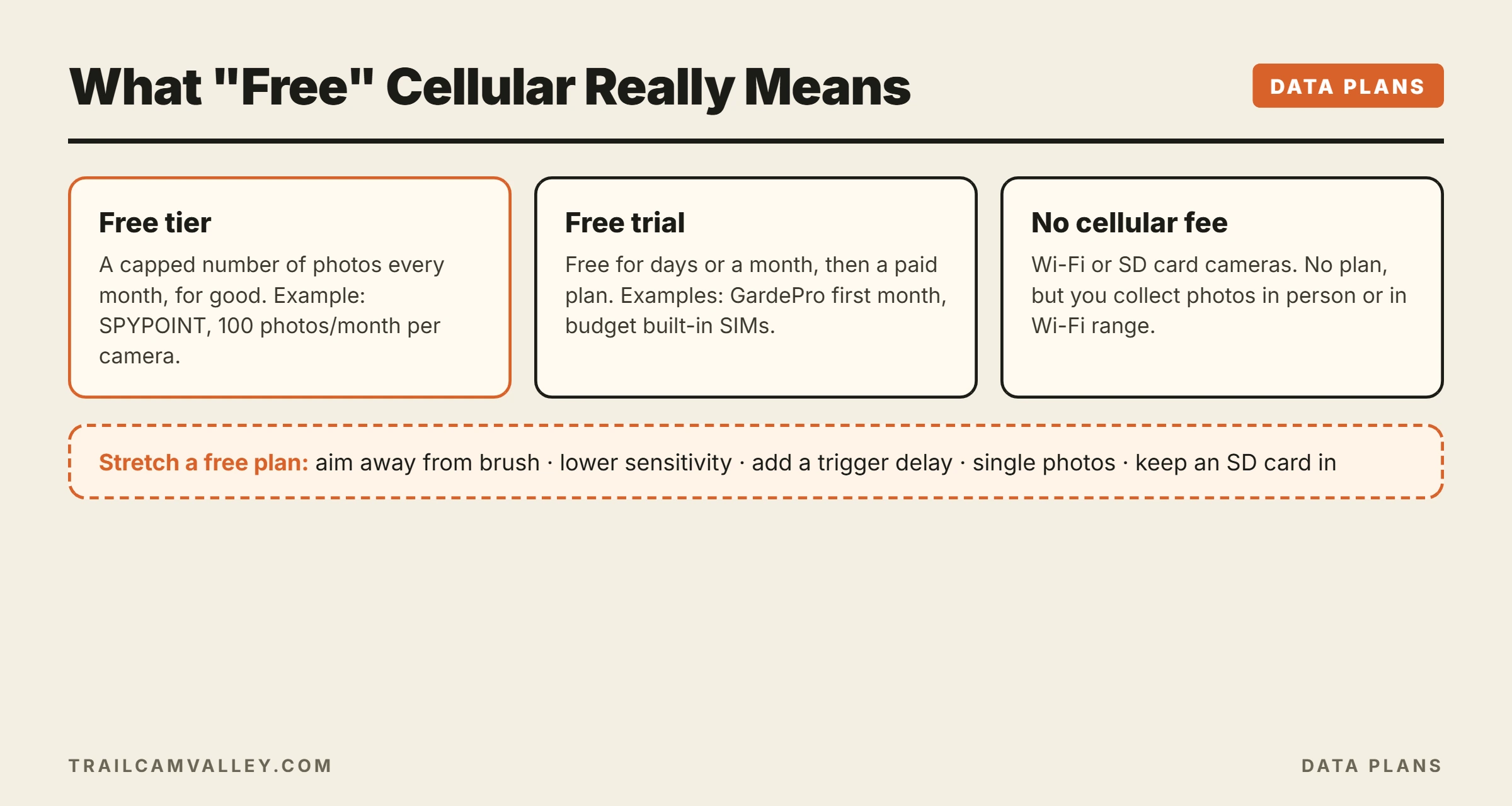
| Free tier | A capped number of photos every month, for as long as you want | SPYPOINT free plan, 100 photos/month |
| Free trial | Paid features free for a short time, then billing starts | GardePro first month free; budget built-in SIM trials |
| No cellular fee at all | Cameras that don’t use cellular | Wi-Fi and SD card cameras |
SPYPOINT’s Free Plan
SPYPOINT built its cellular line around a free option. Its retail listings, such as this Flex-M listing, describe up to 100 photos per month with no fees and no long-term commitment. Paid plans start at $5 per month for 250 photos, with unlimited at $15 per month on monthly billing, according to a SPYPOINT listing on Walmart.
One useful detail: Grand View Outdoors explains that once you hit your monthly allowance on any SPYPOINT plan, extra photos are still saved to the SD card for you to collect in person. So hitting the cap does not mean losing photos, only that they stop arriving on your phone.
For full pricing, see our SPYPOINT data plans guide and is SPYPOINT a good trail camera?
How Far Do 100 Free Photos Go?
It depends entirely on where the camera sits. A buyer’s guide on TrailCamHQ notes that a busy camera on a good trail can blow past 100 photos in a few days, and that most serious users end up on a paid plan in the $5 to $13 range per camera.
- Works well: remote trails, security watch on a quiet gate, off-season monitoring, a backup camera.
- Runs out fast: feeders, food plots, scrapes during the rut, anything with swaying brush.
Free Trials From Other Brands
- GardePro: the company’s own plan comparison advertises the first plan on an account free for one month.
- Budget built-in SIM cameras: many come with a few days of trial data before a paid plan is needed. See our guide to trail cameras with SIM cards.
- Moultrie, Tactacam, Stealth Cam, Muddy: these brands require a paid plan to send photos. Compare them in Moultrie Mobile plans, Tactacam Reveal plans, and Stealth Cam data plans.
Watch Out for “No Monthly Fee” Claims
Some listings advertise cellular cameras with “no monthly fee.” A guide on The Tools Trunk calls reading “no monthly fees” as “free unlimited cellular” the most common mistake, and points out that real cellular transmission uses carrier data, so free options are either capped or time-limited. When you see a no-fee claim, check whether it is:
- A Wi-Fi or Bluetooth camera (not cellular at all)
- A short trial
- A capped free tier
- A camera with no cellular at all, just marketed confusingly
No-Fee Alternatives
Wi-Fi trail cameras
Wi-Fi models let you download photos to your phone when you are within range, with no subscription. Great for backyards and sites you walk past. See Wi-Fi vs cellular trail cameras.
Standard SD card cameras
No plan, lowest cost, and often the best image quality per dollar. You just have to walk in to check them. See what is a non-cellular trail camera and best trail cameras without a subscription.
Mix and match
Many hunters run one cellular camera at their best spot and several SD card cameras elsewhere. That keeps monthly costs low while still giving real-time intel where it counts.
How to Stretch a Free Plan
- Aim away from moving brush and trim branches in the frame.
- Lower sensitivity and set a trigger delay of a minute or more.
- Use single photos instead of bursts.
- Use the camera’s AI or filters if available to send only deer or people.
- Keep a large SD card in so photos beyond the cap are still saved. See SD cards for trail cameras.
- Upgrade for the rut only, then drop back to free.
Real Cost Over Three Years
TrailCamHQ makes a good point: a $10 per month plan adds up to $360 over three years, before you even count the camera. For one or two quiet cameras, a free tier can save hundreds. For busy cameras, a cheap paid plan is usually worth it. Our guide on how much a cellular trail camera plan costs walks through the math.
Is Paying for a Plan Worth It?
For many hunters, yes, at least for one or two cameras. A paid plan pays off when the photos change what you do: telling you when a buck starts moving in daylight, when a bear hits your bait, or when someone opens your gate. In those cases, a few dollars a month can save wasted sits and gas money. If your camera is mostly there for fun, or watches a spot you check anyway, a free tier or a non-cellular camera is often all you need.
Which Brand Is Best on a Tight Budget?
If your top priority is keeping monthly costs at zero, a SPYPOINT camera on the free tier is the most straightforward option for light use. If you need more photos but still want low costs, look at the entry-level paid plans from SPYPOINT, Stealth Cam, Muddy, and Tactacam, which typically start around $5 per month. And if you can visit the camera regularly, a quality SD-card camera often gives the best photos for the money with no plan at all.
Quick Facts
- SPYPOINT’s free plan sends up to 100 photos per month with no fees or commitment (SPYPOINT retail listings).
- SPYPOINT paid plans start at $5 per month for 250 photos (SPYPOINT via Walmart).
- Photos beyond the monthly allowance are saved to the SD card (Grand View Outdoors).
- GardePro offers the first plan on an account free for one month (GardePro).
- Free cellular is always capped or time-limited (The Tools Trunk).
Frequently Asked Questions
Is there a cellular trail camera with no monthly fee?
SPYPOINT’s free tier is the closest, at 100 photos per month. Truly unlimited free cellular service does not exist.
Do free plans include video?
Usually not, or only limited previews. Check the plan details for your camera.
Can I switch from free to paid during the season?
Yes, most brands let you upgrade in the app and drop back later.
Does a free plan work on multiple cameras?
SPYPOINT’s free plan applies per camera, so each camera gets its own 100 photos.
What happens when I hit the free limit?
Photos stop arriving on your phone until the next month, but cameras with an SD card keep saving them.
Can I use a cellular camera without any plan?
It can still record to an SD card if it has one, but it will not send photos. See what a cellular trail camera is and how it works.
Final Thoughts
Free cellular trail camera plans are real, but they are a cap, not a giveaway. SPYPOINT’s 100-photos-per-month tier is great for quiet spots and backup cameras, while busy spots will need a paid plan. Know the difference between a free tier and a free trial, stretch your allowance with smart settings, and mix in Wi-Fi or SD card cameras to keep your total costs down.