
Trail Camera Strategy During the Rut: Where to Put Cameras in November
The rut is the one time of year when mature bucks lose some of their caution and move in daylight. It is also the time when most hunters leave their trail cameras in the same summer spots and miss the action. A good trail camera strategy during the rut means moving cameras as deer behavior changes, roughly every one to two weeks through November.
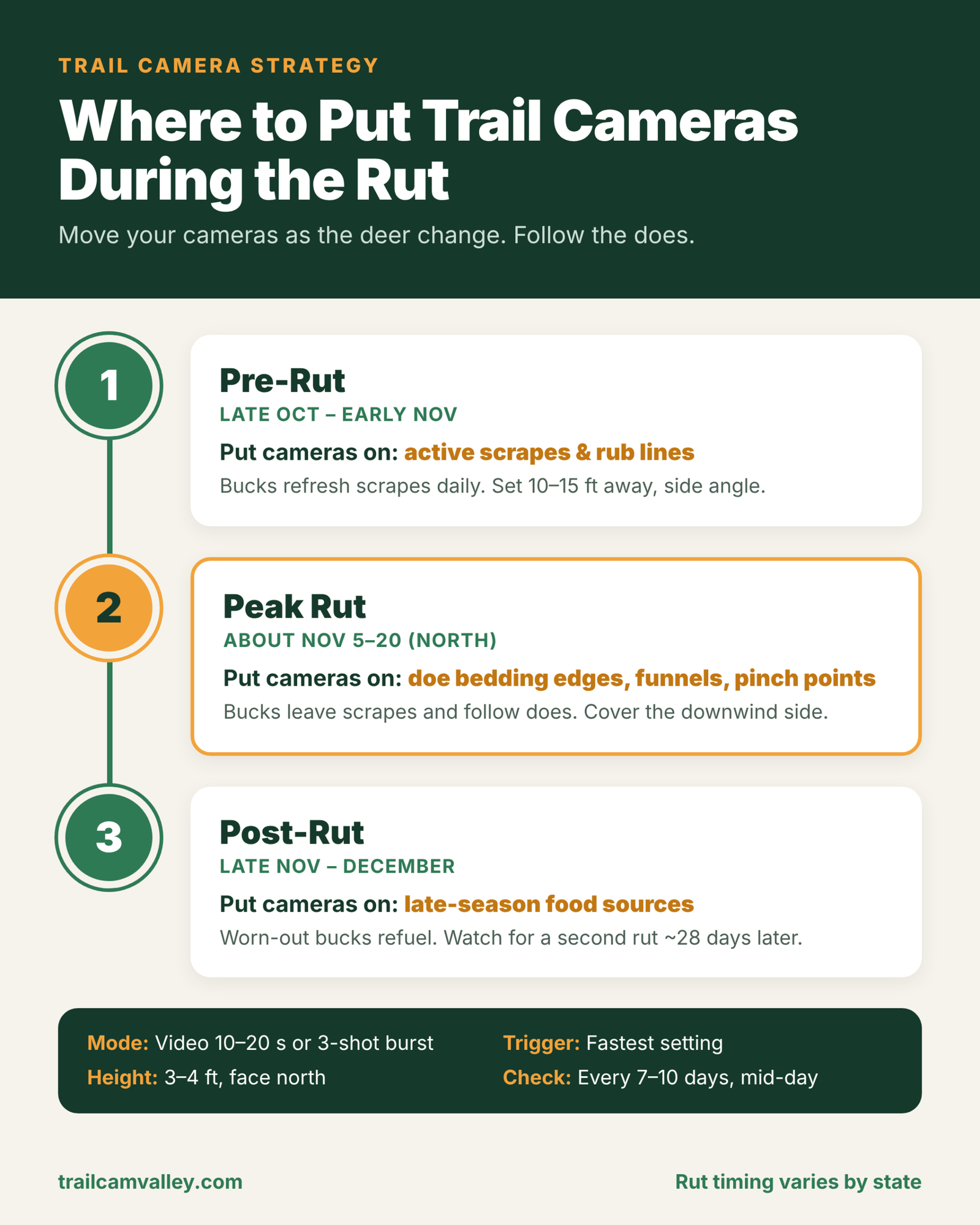
During the pre-rut, put cameras on active scrapes and rub lines. During the peak rut, move them to doe bedding edges, funnels and pinch points between bedding areas, because bucks follow does and stop checking scrapes. In the post-rut, shift cameras back to the best late-season food sources. Use video or 3-shot burst, a fast trigger, and check cameras mid-day or by cellular so you don’t spook deer.
- Pre-rut (late Oct – early Nov)
- Scrapes, rub lines, field edges
- Peak rut (about Nov 5–20 in the North)
- Doe bedding edges, funnels, pinch points
- Post-rut (late Nov – Dec)
- Food plots, standing crops, acorn flats
- Best mode
- Video (10–20 s) or 3-shot burst
- Camera height
- 3–4 ft, angled slightly down, facing north
- Check cameras
- Every 7–10 days, mid-day, or use cellular
Why the Rut Changes Where Your Trail Camera Should Be
For most of the year, a buck’s day is simple: bed, feed, and travel between the two. That pattern is what summer and early-fall cameras on food sources capture so well. Once the rut starts, bucks stop thinking about food and start thinking about does. Their range expands, they travel at odd hours, and they move through cover they normally avoid.
If your camera stays on the same soybean field you watched in September, you will mostly see does, fawns and young bucks. The mature buck you had on camera in velvet may still be around, but he is now cruising downwind of bedding areas and checking travel corridors. The fix is to follow the deer, not your old camera spots.
Pre-Rut, Peak Rut and Post-Rut: Where to Put Cameras in Each Phase
The rut is not one event. It runs in phases, and each phase has a different “best” camera location. Exact dates depend on where you hunt, but in most northern and Midwestern states the peak falls in the first three weeks of November. Southern states can be weeks or even months later. Check your state wildlife agency for local timing, or read our guide to hunting deer in November.
1. Pre-Rut (late October to early November): scrapes and rub lines
This is the best time all year for scrape cameras. Bucks are making and refreshing scrapes to leave scent, and they visit them regularly, often at night but increasingly in daylight. Rub lines also show you which direction bucks are traveling between bedding and food.
- Put a camera 10–15 feet from an active scrape with an overhanging licking branch.
- Angle the camera from the side so a buck walks across the frame, not straight at the lens.
- Look for scrape clusters on field edges, old logging roads and inside corners of fields.
2. Peak Rut (seeking, chasing and lockdown): doe bedding edges and funnels
When does start coming into estrus, bucks largely abandon their scrapes. This is the most common mistake hunters make: they keep cameras on scrapes and conclude “the bucks disappeared.” In reality, the bucks are where the does are.
- Doe bedding edges: place cameras on trails along the downwind side of thick doe bedding cover. Bucks scent-check these edges all day.
- Funnels and pinch points: creek crossings, fence gaps, narrow strips of timber between two fields, and saddles in ridges force cruising bucks into a small area.
- Lockdown: for a few days a buck may stay with one doe and barely move. Fewer buck photos during this time is normal, not a sign the deer left.
Learn how to place cameras on these routes in our guide on where to place trail cameras.
3. Post-Rut (late November and December): back to food
After the main breeding is over, bucks are worn out and have lost a lot of body weight. Their focus returns to food, especially high-energy sources as the weather turns cold. Move cameras back to the best late-season food: standing corn or beans, brassica food plots, and white oak acorn flats. Keep one camera on a doe bedding edge, because unbred does and doe fawns can come into estrus about 28 days later, creating a smaller “second rut.”
Best Trail Camera Settings for the Rut
Rutting bucks move faster and in less predictable directions than feeding deer. A few setting changes help you capture them instead of getting empty frames or tail shots.
- Mode: use video (10–20 seconds) on scrapes and funnels to see behavior such as chasing, licking branch use and grunting. Use a 3-shot burst on trails if your SD card or data plan is limited.
- Trigger speed: choose the fastest setting your camera allows. Read our guide on setting trigger speed.
- Detection delay: keep it short (5–30 seconds) at funnels, where several deer pass close together.
- PIR sensitivity: use high in cold weather. Colder air makes body heat easier to detect, but turn it down if wind and brush cause false triggers.
- Batteries: switch to lithium AA batteries before the cold sets in. They hold up much better than alkaline below freezing.
How to Check Trail Cameras During the Rut Without Spooking Deer
Every walk to your camera leaves scent and noise near the places mature bucks are using. During the rut, that pressure matters more than at any other time.
- Check mid-day (around 11 a.m. to 2 p.m.), when deer are most likely bedded.
- Go every 7–10 days, not every day. Swap SD cards instead of reviewing photos on site.
- Use scent control: rubber boots, gloves, and the same access route each time.
- Consider a cellular trail camera for your most sensitive spots, like bedding edges. You see photos on your phone and never have to walk in. See how cellular trail cameras work.
More tips in our guide on using a trail camera without spooking deer.
How to Turn Rut Camera Photos Into a Hunting Plan
Trail camera photos are only useful if you act on them. Each time you pull a card, write down three things for every buck photo: the time, the direction he was traveling, and the wind. After two or three checks, a pattern usually shows up. For example, a buck may pass a funnel heading into the wind in the last hour of daylight.
When you see daylight photos of a target buck in the same area more than once, set up a stand downwind of that route and hunt it on the next day with the right wind. During the peak rut, daylight activity can happen at any hour, so all-day sits near doe bedding areas are worth it. If you are new to this, start with our beginner’s guide to setting up a trail camera for deer hunting.
Common Trail Camera Mistakes During the Rut
- Leaving cameras only on food sources or summer spots.
- Keeping cameras on scrapes after the peak rut starts.
- Checking cameras too often, especially near bedding areas.
- Facing cameras east or west, so sunrise or sunset washes out the photos.
- Mounting too high, so a fast-moving buck passes under the detection zone.
Frequently Asked Questions
Where is the best place to put a trail camera during the rut?
During the peak rut, the best places are the downwind edges of doe bedding areas and natural funnels such as creek crossings, fence gaps and narrow strips of timber. Before the peak, active scrapes are best.
Do bucks still use scrapes during the rut?
Bucks visit scrapes most in the pre-rut. Once does come into estrus, scrape activity drops sharply because bucks spend their time searching for and following does. Some scrapes become active again in the post-rut.
Should I use video or photos on my trail camera during the rut?
Video is better on scrapes and funnels because it shows behavior and which way the buck went. Use 3-shot burst photos if your SD card space or cellular data plan is limited.
How often should I check my trail camera during the rut?
Every 7 to 10 days is enough for most spots. Go in mid-day, use the same route and keep your scent down. Use a cellular camera for spots close to bedding.
When is the rut in 2026?
In most northern and Midwestern states, the peak rut falls between early and late November. Southern states are later, sometimes in December or January. Your state wildlife agency publishes local timing.