
Deer Movement by Moon Phase: What Trail Camera Data Really Shows
Few hunting topics start more arguments than the moon. Some hunters plan their whole season around moon phase charts. Others say it makes no difference at all. If you run trail cameras, you do not have to pick a side. You can look at what researchers found and then check it against your own photos. Here is what we really know about deer movement by moon phase.
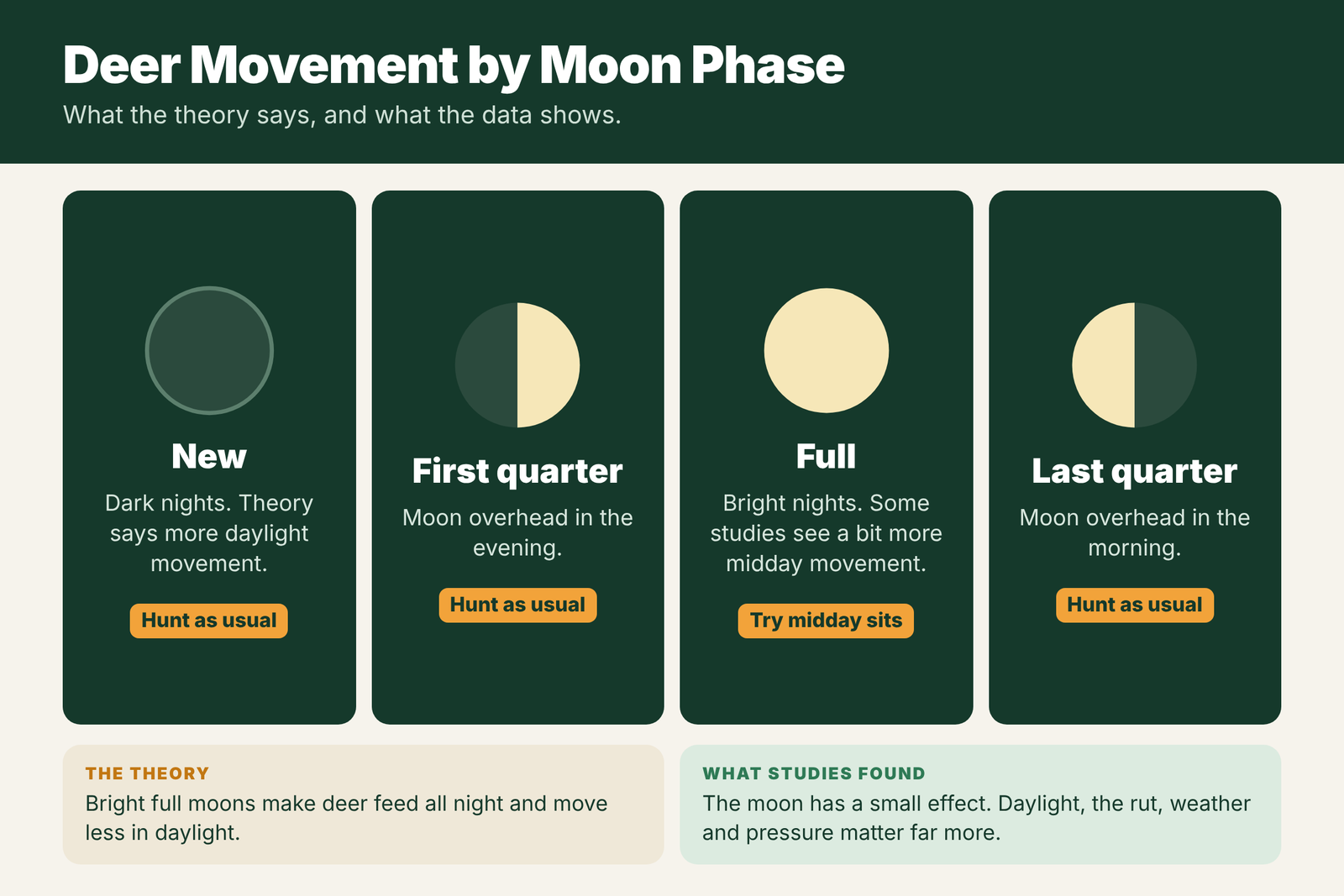
The moon has only a small effect on deer movement. Studies that tracked deer with GPS collars found that day length, season, the rut, temperature and hunting pressure matter much more. Some studies saw a little more midday movement around the full moon, but not the big drop in daylight activity the old theory claims. Do not skip a good hunting day because of the moon. Log moon phase on your trail camera photos and see if it matters on your land.
- Old theory
- Full moon = deer feed at night, move less by day
- Research finding
- Moon effect is small and not consistent
- Bigger factors
- Daylight, rut, temperature, pressure
- Full moon tip
- A midday sit can pay off
- Rut timing
- Not shifted by the moon
- Best test
- Your own camera data over 2+ seasons
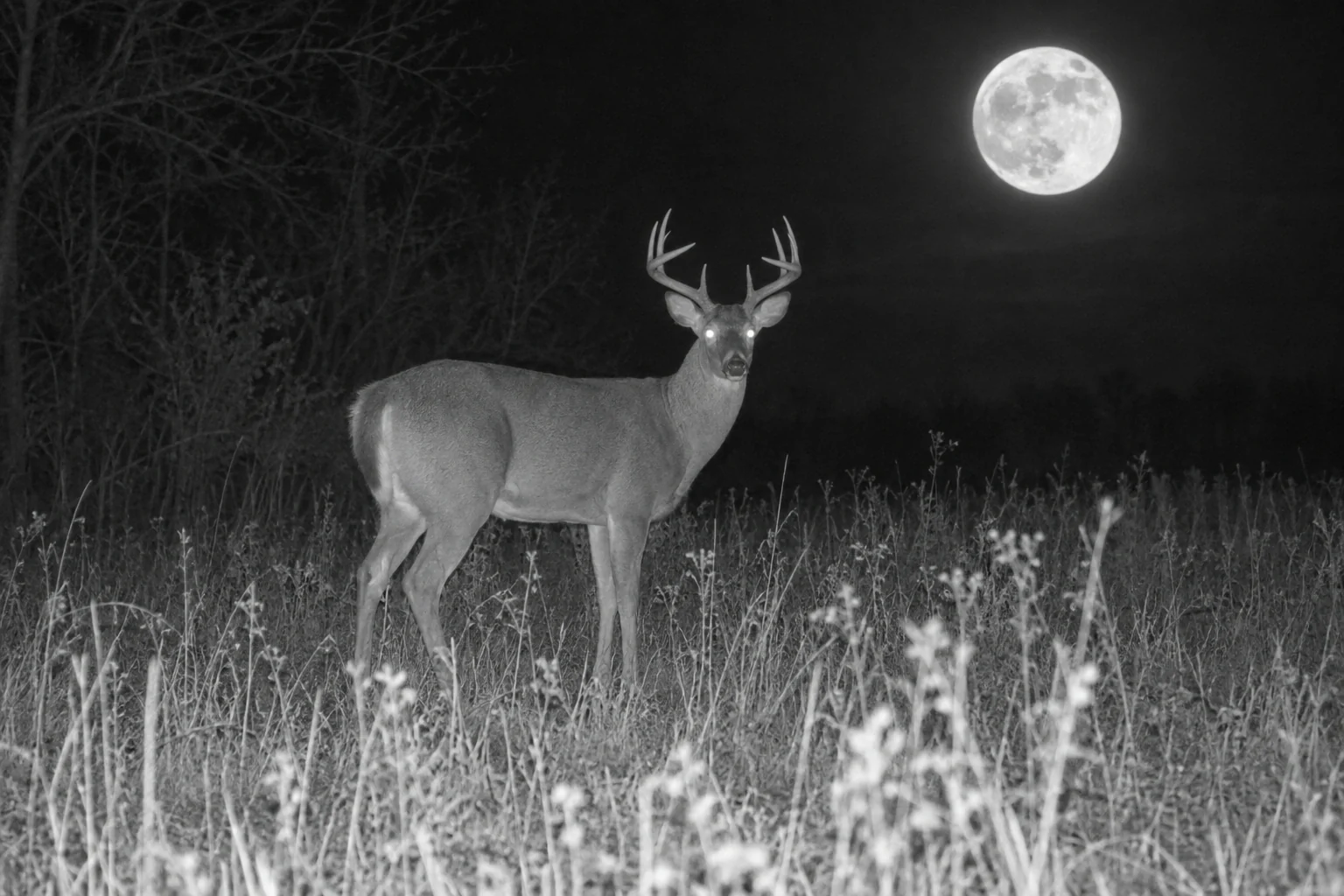
The Moon Theory in Plain Words
The moon theory comes in a few versions, but they share one idea: the moon controls when deer feel safe to move.
- Moon brightness: on a bright full moon, deer can see well at night, so they feed all night and stay bedded in daylight. On a dark new moon, they move more at dawn and dusk.
- Moon position: deer move more when the moon is directly overhead or underfoot (moon “transit”), like the “solunar” tables used for fishing.
- Rut moon: a certain full moon in the fall (sometimes called the “hunter’s moon” or “rutting moon”) sets off the rut.
Many apps and “deer movement forecasts” are built on these ideas. They give each day a score, often with stars or colors.
What Research and Trail Camera Studies Found
Over the last few decades, university researchers have put GPS collars on hundreds of deer and recorded their location every few minutes, day and night. Large trail camera studies have looked at hundreds of thousands of photos. The results are fairly clear:
- The moon effect is small. Changes in daily movement between moon phases are minor compared to changes caused by time of day, season and weather.
- Full moon does not stop daylight movement. Some studies found deer moved a little more in the middle of the day around the full moon, not less at dawn and dusk.
- Moon position (overhead/underfoot) shows weak or no pattern in most data sets.
- The rut is not timed by the moon. Studies of breeding dates show the rut lands at nearly the same time every year in a given area, set by day length. Read more in when deer go into rut.
What does change daylight movement in a big way? A sharp drop in temperature, the seeking and chasing phase of the rut, less hunting pressure, and wind. These are the things to plan around first.
Full Moon vs New Moon on Your Trail Camera
If you look through a season of trail camera photos, here is what you will often see:
- Full moon nights: more photos spread across the whole night, sometimes a few more photos around midday. Night photos may look brighter on cameras with a weak flash, because the moon adds light. Learn more in how a trail camera works at night.
- New moon nights: very dark, so night photos depend fully on the infrared flash. Deer still move at night.
- Dawn and dusk: the busiest times in both phases. That is true for almost every camera, every month.
Deer are crepuscular, which means they are most active at dawn and dusk, not truly nocturnal. Our guide to whether deer are nocturnal explains why pressured deer move more at night no matter what the moon is doing.
How to Check the Moon Effect on Your Own Cameras
Every property is a little different. Here is a simple way to test the moon on yours:
- Turn on the moon icon in your camera’s info strip, or look up the moon phase for each date later.
- Log every deer photo with date, time and camera in a spreadsheet. Our guide to building a deer movement chart shows the columns to use.
- Add a “daylight” column: yes if the photo was taken between sunrise and sunset.
- Group by moon phase (new, first quarter, full, last quarter) and work out the percent of photos taken in daylight for each phase.
- Compare with weather: check whether a cold front happened in the same week. Weather often explains what looks like a moon effect.
Use at least two seasons of data before you trust a pattern. One month is too short, because weather and the rut can easily hide or fake a moon effect.
Practical Hunting Tips by Moon Phase
- Hunt the good days, whatever the moon. A cold morning with the right wind beats a “five-star” moon day with a warm south wind.
- Around the full moon, try a midday sit, especially during the rut. Pack lunch and stay from late morning to early afternoon near bedding cover.
- On a new moon, morning hunts near bedding can be strong because deer return to cover at first light.
- Do not skip the rut because of the moon. The peak rut comes at the same time every year where you hunt, and it is the best time of the season whatever the moon looks like. See our tips for deer hunting during a full moon.
Frequently Asked Questions
Does the moon phase affect deer movement?
Only a little. GPS-collar and trail camera research shows that moon phase has a small effect on deer movement compared to daylight, season, the rut, temperature and hunting pressure.
Do deer move less during a full moon?
Not by much. Deer still move at dawn and dusk during a full moon, and some studies found slightly more movement in the middle of the day around the full moon.
Does the moon start the rut?
No. Research on breeding dates shows the rut happens at about the same time every year in a given area, because it is triggered by day length, not the moon.
Are moon-based deer movement apps accurate?
They are not very reliable, because they rely mostly on the moon, which has a small effect. Weather forecasts and your own trail camera data are better guides.
What is the best time to hunt during a full moon?
Hunt dawn and dusk as usual, and add a midday sit near bedding cover, especially during the rut. Cold fronts during a full moon can bring good daylight movement.