
Why Do Deer Run in Front of Cars? (November Is the Worst Month)
Almost every driver in deer country has a story: a deer standing in the headlights, then bolting straight into the road instead of away from it. Deer-vehicle collisions cause over a million crashes a year in the United States, and fall is by far the worst season. So why do deer run in front of cars, and what can you do to avoid hitting one?
Deer run in front of cars because they cannot judge the speed of a fast car, they are often blinded by headlights and freeze or bolt in a random direction, and their instinct is to run toward cover or the rest of their group, even if the road is in the way. November is the worst month because the rut has bucks chasing does without caution, and shorter days put rush hour right at dawn and dusk, when deer move most. Slow down, use high beams when you can, expect more deer behind the first one, and brake instead of swerving.
- Worst months
- October to December
- Peak month
- November (the rut)
- Worst times
- Dawn and dusk, especially 5–9 p.m.
- Headlight freeze
- Bright light blinds eyes adapted to the dark
- Deer whistles
- No solid proof they work
- Safest reaction
- Brake firmly and stay in your lane
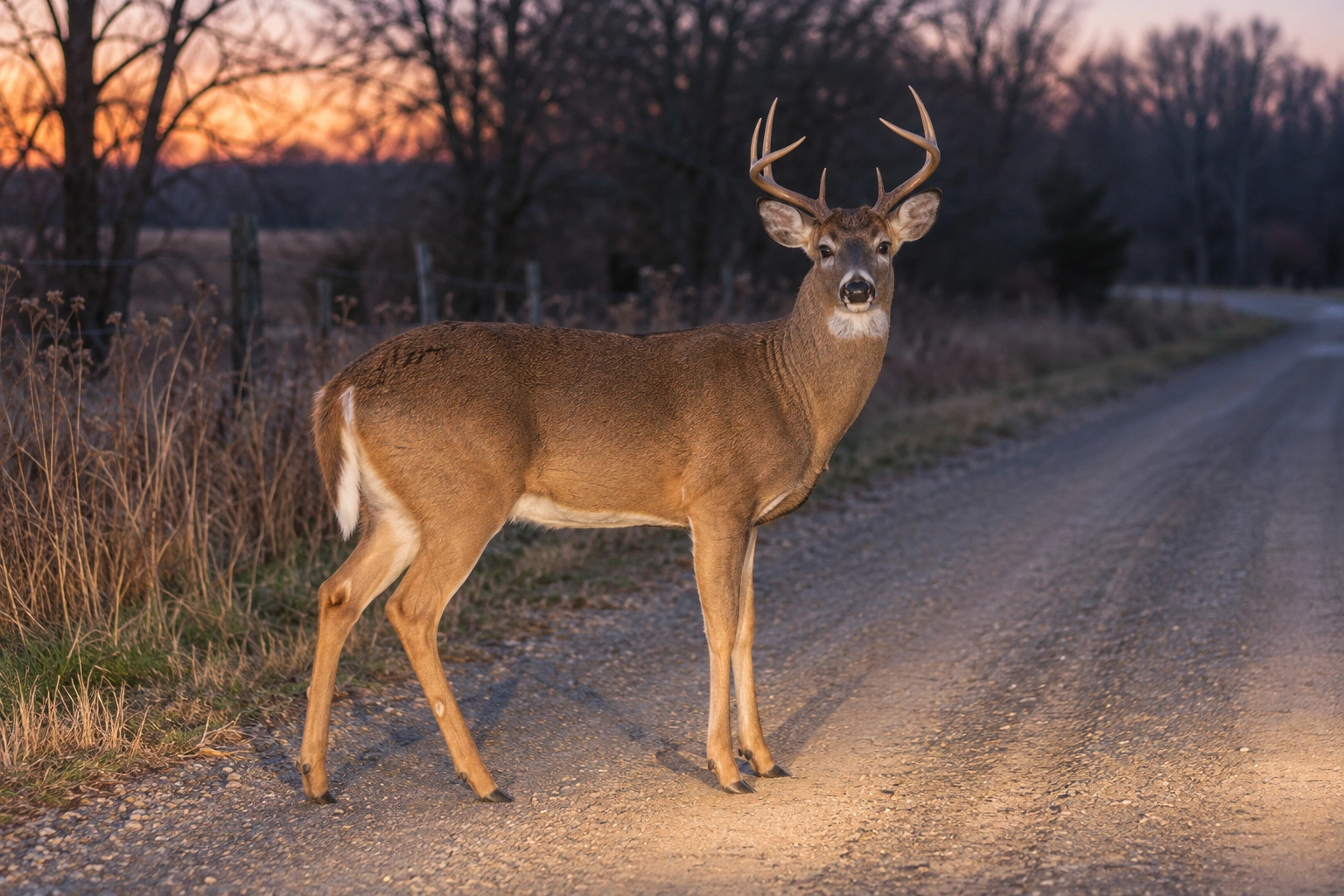
Why November Is Peak Deer Collision Month
Insurance claim data shows the same pattern every year: deer crashes climb in October, peak in November, and stay high in December. Three things line up at once:
- The rut. Bucks travel far more than usual looking for does, often in daylight and across roads they normally avoid. Does being chased run in panic. Read more about timing in when deer go into rut.
- Shorter days. After daylight saving time ends, evening rush hour falls right at dusk, when deer are most active. The same happens in the morning.
- Hunting season. Hunters in the woods push deer to move more, sometimes across roads. Check our guide on when deer hunting season is.
Food also plays a part. As crops are harvested and the weather turns colder, deer change their feeding areas and travel routes.
Why Deer Freeze in Headlights
Deer eyes are built for low light. They have a large pupil and a reflective layer behind the retina (the tapetum lucidum, which makes their eyes glow in your lights) that lets them see well at dawn, dusk and night. When a bright headlight hits those eyes, the deer is suddenly blinded. It cannot tell where the light is coming from or how far away it is.
A blinded deer usually does one of two things:
- Freezes, because standing still is a deer’s first defense against predators.
- Bolts in a random direction, which can be straight into your path.
Deer also have no natural way to judge something moving at 55 mph. A predator runs at them, not along a fixed line at high speed, so their escape instincts are not made for cars. Deer are mostly active at dawn and dusk, as explained in are deer nocturnal, which is exactly when visibility on the road is worst.
Why Deer Jump Into the Road Instead of Away From It
- They run toward cover or home. A spooked deer often runs back toward the woods it came from or its bedding area, even if that means crossing the road again.
- They follow the group. Deer travel in family groups. If one crosses, others follow, often running to catch up. One deer usually means more behind it.
- Rutting bucks are not paying attention. A buck chasing a doe is focused on her, not on traffic.
- They are fast. Deer can reach about 30–40 mph and jump a long way in one bound. See how fast a deer can run. They can be in front of your car before you can react.
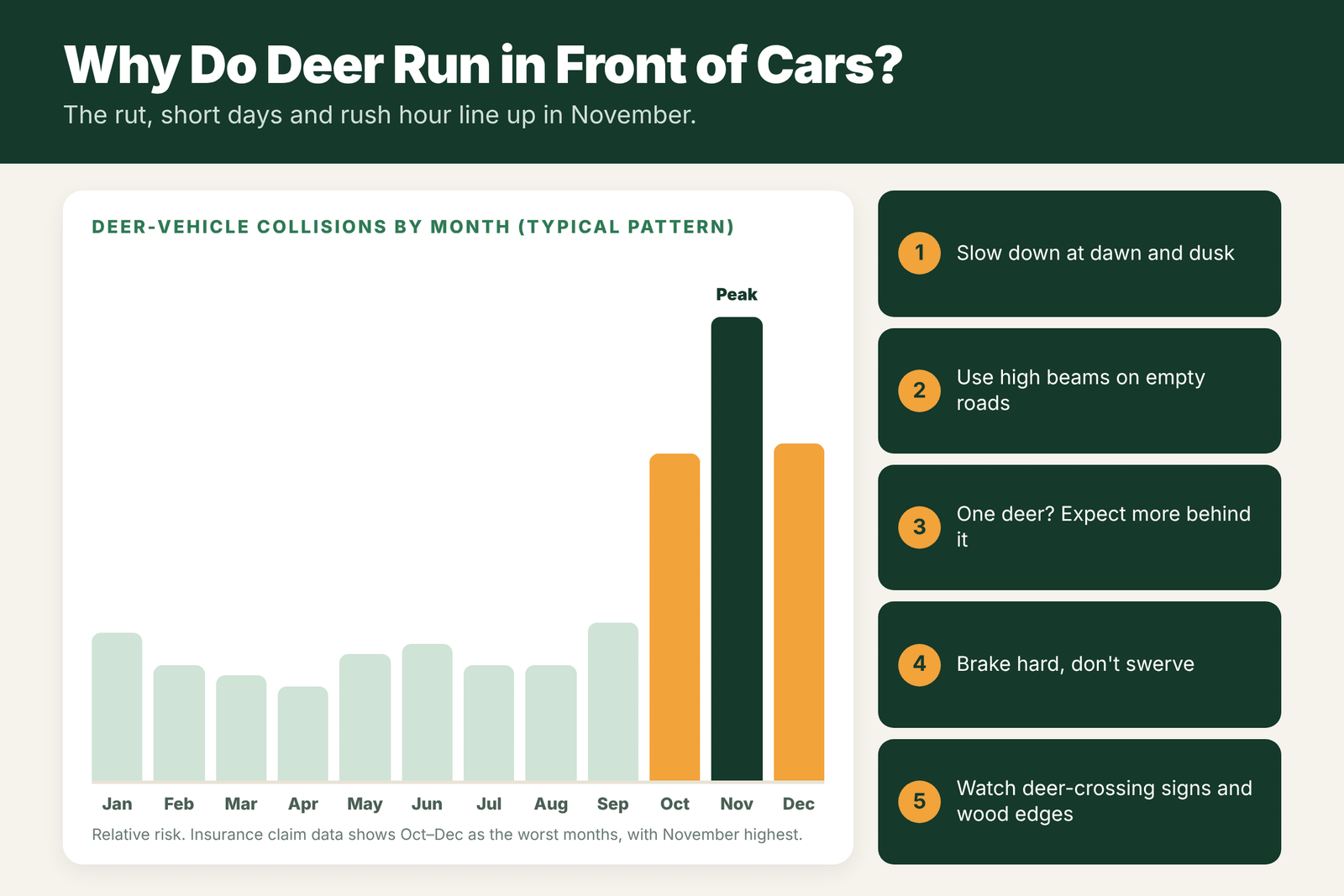
Where and When Deer Collisions Happen
- Time: the first hours after sunset and the hour around sunrise are the worst. Many crashes happen between about 5 and 9 p.m. in the fall.
- Roads: two-lane rural roads and highways through farm country, especially where woods and fields meet the road.
- Crossing points: creek bottoms, wooded draws and fence lines that run up to the road. These are natural deer travel routes.
- Signs: yellow deer crossing signs are placed where crashes have happened before. Take them seriously.
Do Deer Whistles Work?
Deer whistles are small devices you stick on your car that are supposed to make a sound that scares deer off the road. Studies by universities and researchers have not found good evidence that they work. In tests, the sound often could not be heard over road noise, or deer did not react to it. They are cheap, so some people use them anyway, but do not count on them. Slowing down and paying attention work much better.
How to Avoid Hitting a Deer
- Slow down at dawn and dusk, especially in October through December.
- Use high beams when there is no oncoming traffic. You will see eye-shine sooner.
- Scan the road edges, not just the lane in front of you.
- If you see one deer, expect more. Slow down and watch for others following.
- Brake firmly, stay in your lane, and do not swerve. Many of the worst injuries come from swerving into oncoming traffic or off the road, not from hitting the deer.
- Honk with a long blast if a deer is standing on the road. It may help it move.
- Wear your seatbelt. It is the best protection if a crash happens.
What to Do If You Hit a Deer
- Pull over safely and turn on your hazard lights.
- Check for injuries and call 911 if anyone is hurt or the car is blocking the road.
- Stay away from the deer. A hurt deer can kick and cause serious injury.
- Report the crash to local police or the state wildlife agency. Some states require it, and you may need a report for insurance.
- Take photos of the car and the scene for your insurance company.
- Check local rules before keeping the deer. Some states allow you to keep road-killed deer with a permit.
Deer Collision Risk at a Glance
Insurance industry estimates put US animal collision claims at well over a million a year, and deer cause most of them. Risk is not spread evenly, though. It rises and falls with the season, the time of day and the kind of road you drive.
| Factor | Higher risk | Lower risk |
|---|---|---|
| Month | October to December, peak in November | Late spring and summer |
| Time of day | Dusk to a few hours after dark, and dawn | Midday |
| Road type | Two-lane rural roads near woods, creeks and fields | City streets and open, treeless highway |
| Landscape | Wooded corridors, river bottoms, field edges | Wide open land with no cover |
| Driver behavior | Speeding, low beams on dark roads, distracted | Slower speed, high beams, scanning edges |
What Happens in the Car: Seconds That Matter
At 55 mph, a car covers about 80 feet every second. If you take about 1.5 seconds to see a deer and react, you have already traveled roughly 120 feet before you touch the brake, and stopping can take another 130 feet or more on dry pavement. That is why low-beam headlights, which may light only a few hundred feet ahead, leave so little margin on a dark country road.
Dropping to 45 mph makes a big difference. You cover less ground while you react, you stop in a shorter distance, and if a crash does happen, it hits with less force. On roads with deer crossing signs in the fall, slowing down by even 10 mph is one of the most effective things you can do.
Real Scenarios and What to Do
A deer is standing in your lane. Brake firmly, give a long honk and flash your lights. Do not drive around it until it moves, because it may jump back into your path.
A deer crosses ahead of you. Slow down right away. Deer often travel in groups, and in November a buck may be following a doe. Expect a second or third deer to cross in the same spot.
A deer jumps out at close range. Brake hard in a straight line and hold the wheel steady. Hitting the deer is usually safer than swerving into oncoming traffic, a tree or a ditch. If you are on a motorcycle, brake and aim for an open space if there is one, and wear protective gear.
You see eye-shine at the road edge. Treat it like a stop sign coming up. Ease off the gas and get ready to brake until you are past it.
Insurance and Damage Basics
- Coverage: in the US, hitting a deer is usually covered by comprehensive coverage, not collision. Check your own policy.
- Swerving matters: if you swerve and hit something else, such as a tree or another car, the claim may be handled as a collision instead.
- Document everything: photos of the car, the road, the deer if it is safe, and a police or wildlife report can make the claim smoother.
- Check the car before driving on: leaking fluid, a broken headlight or a damaged hood latch can make the car unsafe to drive.
How Trail Cameras Show Road Crossings
If deer keep crossing a road near your property or hunting land, a trail camera set back from the road on a crossing trail can show you when they move. Many landowners find deer crossing at the same few spots, often where a creek, fence gap or wooded strip meets the road. Knowing those times and spots helps you drive more carefully and plan your own access. For more on why deer move when they do, see our deer movement chart.
Frequently Asked Questions
Why do deer run in front of cars?
Deer cannot judge the speed of cars, they are blinded by headlights, and their instinct is to run toward cover or their group. In the fall, rutting bucks chasing does pay even less attention to traffic.
What month do most deer collisions happen?
November. Deer collisions rise in October, peak in November during the rut, and stay high in December.
Why do deer freeze in headlights?
Deer eyes are made for low light, so bright headlights blind them. A blinded deer often freezes, which is its natural defense, or bolts in a random direction.
Do deer whistles work?
There is no solid evidence that deer whistles work. Studies found deer often do not react to them. Slowing down and watching the road edges are far more effective.
Should you swerve to avoid a deer?
No. Brake firmly and stay in your lane. Swerving can send you into oncoming traffic, trees or a ditch, which is often more dangerous than hitting the deer.
Is it better to hit a deer or swerve?
In most cases, brake hard and stay in your lane. Swerving can send you into oncoming traffic, a tree or a ditch, which is often more dangerous.
What time of day do most deer collisions happen?
Mostly around dusk and the first few hours after dark, with another rise around dawn.
Does insurance cover hitting a deer?
In the US, it is usually covered by comprehensive coverage. Check your own policy for details.