
Deer Scrape vs Rub: What Your Trail Camera Photos Are Telling You
Walk through the woods in October and you will find two kinds of buck sign: bare patches of pawed-up dirt on the ground and trees with the bark torn off. Both are made by bucks, both get more common as the rut gets close, and both can help you find a deer worth hunting. But they mean different things, and only one of them is usually worth a trail camera. Here is how to read deer scrapes vs rubs and what each one tells you.
A rub is a tree or sapling a buck has scraped with his antlers, leaving bare, shredded bark. A scrape is a patch of ground a buck paws down to bare dirt, usually under a low licking branch. Rubs mostly show where a buck travels. Scrapes are communication spots that bucks and does come back to again and again, which makes a fresh scrape the better place for a trail camera. Use rub lines to find travel routes and put a camera where a rub line meets a scrape or a funnel.
- Rub
- Bark stripped by antlers, on trees 1–8 in. thick
- Scrape
- Pawed bare dirt 1–4 ft wide under a licking branch
- Rubs appear
- Early fall, right after velvet comes off
- Scrapes peak
- Late October to early November (pre-rut)
- Rub tells you
- Travel route and direction
- Best camera spot
- Active scrape, or where a rub line meets one
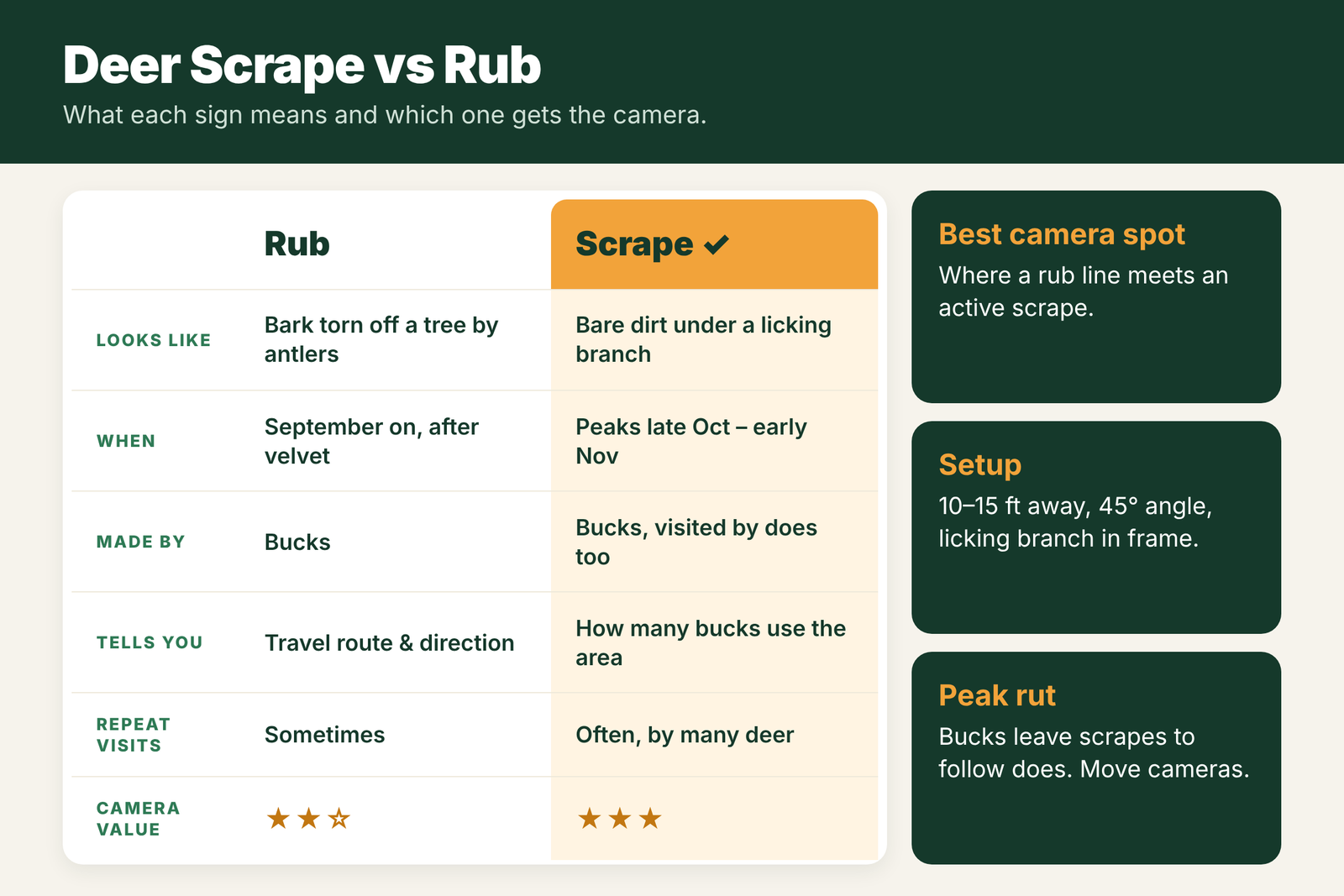
Scrape vs Rub at a Glance
| Rub | Scrape | |
|---|---|---|
| What it looks like | Tree trunk with bark torn off, shiny wood, broken branches | Bare oval of dirt, often with a chewed branch above it |
| Where | Saplings and small trees along trails, field edges, near bedding | Field edges, trail junctions, logging roads, inside corners |
| When | September onward, after velvet shed | Mostly mid-October to mid-November |
| Made by | Bucks | Bucks, but visited by does and other bucks too |
| Main purpose | Leaving scent and marking a route; practice fighting | Scent “message board” between deer |
| Repeat visits | Sometimes, but many rubs are made once | Often visited many times by many bucks |
| Trail camera value | Good for finding routes | Best for photos of many bucks |
What a Rub Tells You
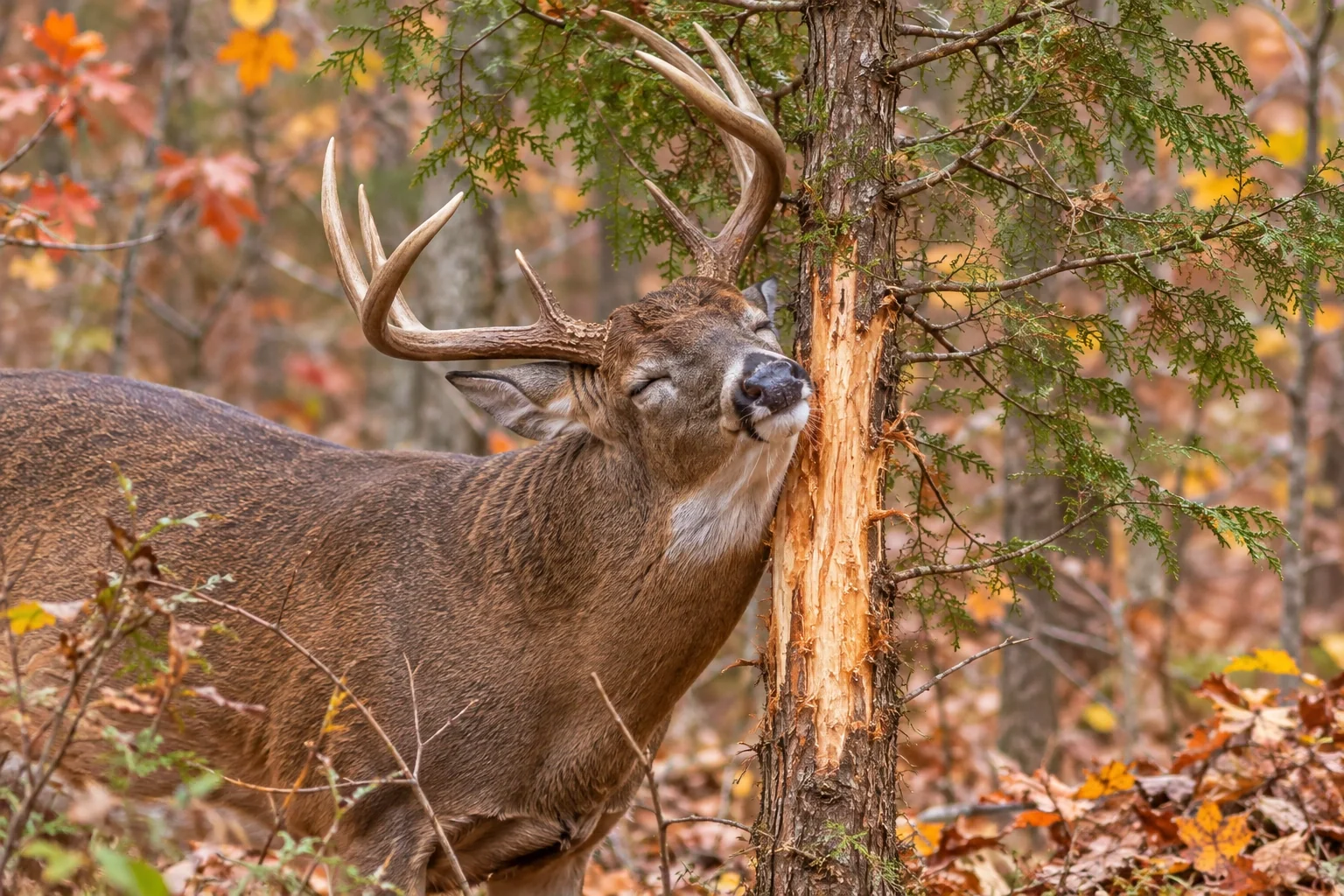
A buck makes a rub by thrashing a tree with his antlers and forehead. It is not only about cleaning off velvet. He also leaves scent from the glands on his forehead, and it lets him build neck strength before the rut. A fresh rub has bright, wet-looking wood and shreds of bark on the ground. An old rub is gray and dry.
Here is what to read from a rub:
- Size of the tree: big bucks rub trees of every size, but young bucks rarely rub trees thicker than a few inches. A rub on a tree as thick as your leg is a good hint that a mature buck is nearby.
- Height of the rub: a rub that starts low and goes up to around 3 feet shows a bigger-bodied deer. Very low, small rubs are usually young bucks.
- Direction: the torn side of the tree usually faces the direction the buck was coming from. Follow a row of rubs and you can see which way he walks, often from bedding to food in the evening.
- Rub lines: several rubs in a line along a trail show a regular travel route. These are great places to hunt and to set a camera that covers the trail.
Note any sign of tines on the rub, too. Deep gouges from the brow tines can show you a buck with a heavy rack. Learn more about antlers in our guide to deer brow tines.
What a Scrape Tells You
A scrape is made in two steps. First the buck works the licking branch above it, a branch 4 to 6 feet off the ground that he chews and rubs with his face. Then he paws the ground below to bare dirt and often urinates into it. Other deer check the scrape, smell who has been there, and add their own scent.
That is what makes a scrape so useful. A good scrape can be visited by many different bucks in a single week, plus does checking to see which bucks are around. It tells you:
- How many bucks use the area, not just one.
- When the rut is building: lots of new scrapes popping up means the pre-rut is in full swing.
- Hot spots: a “community” scrape that comes back in the same spot every year is a long-term hub for deer movement.
- Scrape lines: several scrapes along a field edge or old road show where bucks cruise.
Rub Lines and Scrape Lines: How to Use Them Together
Rubs and scrapes are most useful when you read them as one map. Rub lines show the routes bucks walk. Scrape lines show where they stop to communicate. Where the two meet, you have a spot a buck walks through and stops at.
- Walk the edges in early fall: look along field edges, creek bottoms and trails coming out of thick cover. Drop a pin on your phone for every fresh rub and scrape.
- Connect the dots: on an aerial map, rubs in a line usually point between bedding and food. Clusters of scrapes often sit on the edges of those routes.
- Find the overlap: a scrape on a rub line, a trail junction near both, or a funnel they both run through is your best camera and stand location.
Our guide on tracking animals with a trail camera shows how to turn these pins and photos into a pattern.
Which Sign Deserves a Trail Camera?
If you only have one camera, put it on a fresh, active scrape during the pre-rut. Bucks come back to scrapes and stand still while they work the licking branch, so you get clear photos of many bucks. A single rub, on the other hand, may never be visited again.
Rubs still earn a camera in a few cases:
- A big rub on a large tree that has been rubbed again and again, sometimes called a “signpost rub.” These can get visits from several bucks year after year.
- A rub line on a narrow trail. Aim the camera at the trail, not at the tree, so you catch bucks walking by.
- Early season, before scrapes show up, when rubs are the freshest buck sign you have.
When you set up on a scrape, mount the camera 10–15 feet away at a 45° angle and keep the licking branch in the frame. Our step-by-step guide on setting a trail camera over a scrape covers height, angle and settings. And once the peak rut starts, bucks leave scrapes to chase does, so follow our rut trail camera strategy to move your cameras in time.
Reading Scrape and Rub Photos on Your Trail Camera
- Many bucks, mostly at night, on a scrape: normal. Watch for one buck showing up closer to daylight over time.
- The same buck rubbing the same tree: his core area is very close. Hunt the route between that rub and thick cover.
- Does at a scrape: a good sign that the rut is close. Bucks will follow.
- Scrape activity suddenly drops in November: the bucks have not left. They have switched to chasing does.
If you want to put a number on the bucks you see, our guide on how to score a deer explains how to estimate rack size.
Frequently Asked Questions
What is the difference between a deer scrape and a rub?
A rub is a tree a buck has scraped with his antlers, leaving bare, torn bark. A scrape is a patch of ground a buck paws down to bare dirt, usually under a low licking branch. Rubs mark routes, while scrapes are scent spots many deer come back to.
Should I put a trail camera on a rub or a scrape?
A fresh scrape is usually better, because bucks return to scrapes and stand still while they use them. Put a camera on a rub only if it is a large, repeatedly used rub or part of a rub line along a trail.
Do big bucks make bigger rubs?
Mature bucks rub trees of all sizes, but they are the main ones that rub trees thicker than a few inches. A rub on a large tree is a good sign that a mature buck is in the area.
When do deer start making scrapes and rubs?
Rubs start in early fall, right after bucks shed their velvet. Scrapes become common from mid-October and peak in late October to early November, just before the main rut.
Do does use scrapes?
Yes. Does visit scrapes to smell which bucks are around, and trail cameras often catch them there, especially as the rut gets closer.