
Trail Camera With Color Night Vision: How It Works
Daytime trail camera photos come out in full color, but as soon as the sun goes down, almost every photo turns black and white. If you have ever wished you could see the true color of a buck’s rack or tell a coyote from a fox at night, you have probably looked for a trail camera with color night vision. They do exist, but they work differently from standard cameras and come with trade-offs. Here is how.
Yes, some trail cameras can take color photos at night, in two main ways. White flash cameras fire a bright visible flash, like a regular camera, which gives sharp color photos but is easy for deer to see and can spook them. Starlight or low-light sensor cameras use a very sensitive sensor to capture color from moonlight or other dim light without a flash, but they need some light and work best at short range. Standard infrared (IR) cameras take black-and-white night photos because the sensor only sees reflected infrared light, not color.
- Standard IR
- Black and white at night
- White flash
- Color, but visible to deer
- Starlight sensor
- Color in dim light, no flash
- Best stealth
- No-glow (black) IR
- Best night color
- White flash
- Good for
- Security, wildlife ID, backyards
Why Most Night Photos Are Black and White
Most trail cameras light up the night with infrared (IR) LEDs. Infrared light is just beyond what people can see, and deer see it poorly too. At night, the camera removes its IR-cut filter (that is the small click you sometimes hear) so the sensor can pick up the infrared light bouncing off animals.
The catch is that infrared light carries no useful color information. The sensor records how bright each spot is, not what color it is, so the camera saves the image in black and white. There are two kinds of IR flash:
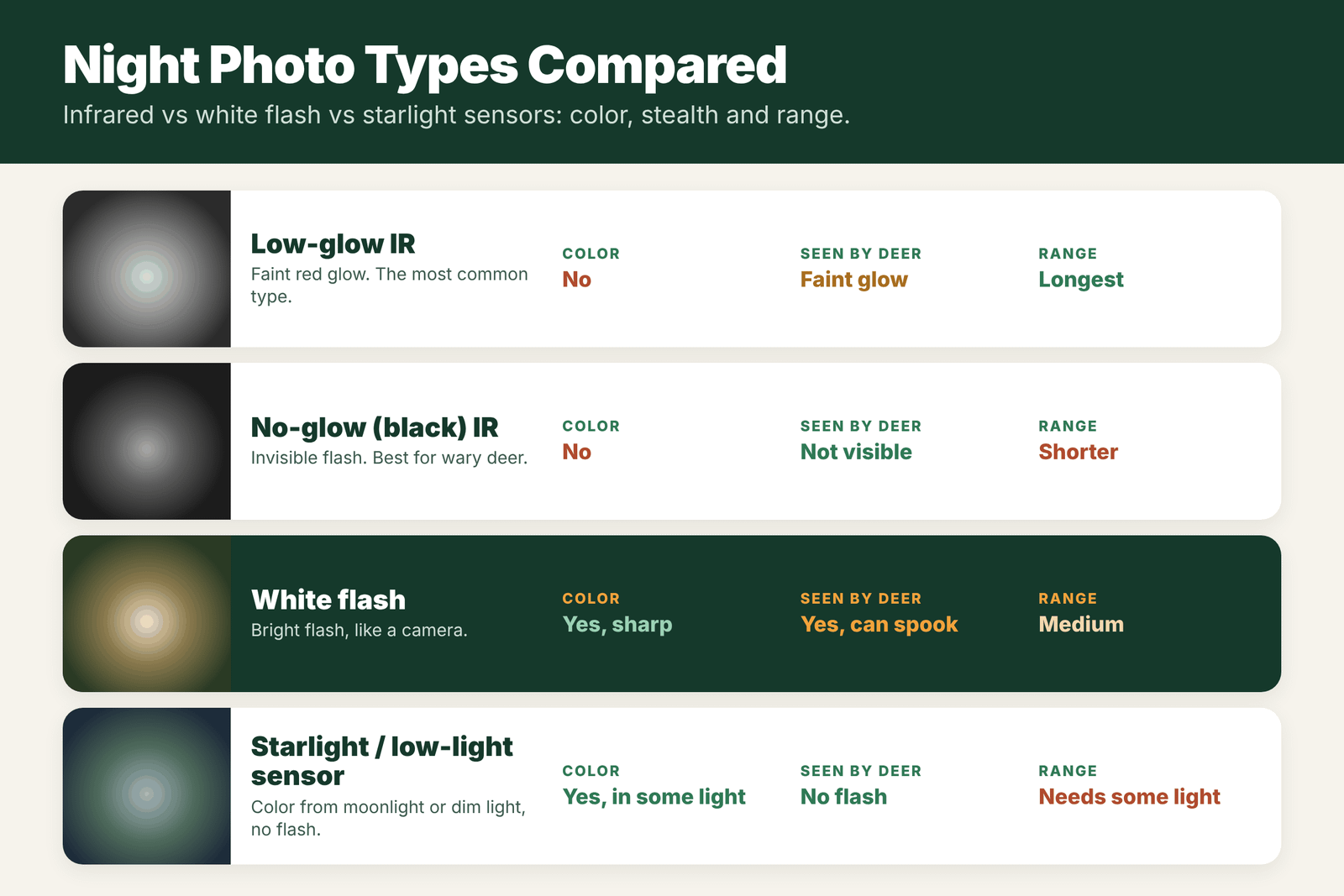
- Low-glow IR (about 850nm): a faint red glow at the LEDs. Longer night range and brighter photos.
- No-glow or black IR (about 940nm): no visible glow. Stealthier, but usually a shorter range and darker photos.
Learn more in trail camera infrared vs black flash and does a trail camera flash at night.
How Color Night Vision Works
To get color, the camera needs visible light, because that is the light that carries color. There are two ways to get it:
- Bring your own light: a white flash or white LEDs light up the scene with visible light, just like a phone or camera flash.
- Use the light that is already there: a very sensitive “starlight” or low-light sensor, often with a wide-open lens, collects enough moonlight, starlight or nearby artificial light to record color.
White Flash vs Starlight Sensors
White flash (xenon or white LED):
- Sharp, full-color night photos, often with less motion blur because the flash is very short.
- Easy for animals and people to see. Some deer get used to it, but mature bucks may avoid the spot.
- Can attract attention from thieves.
- Often uses more battery per photo, and some models have slower recovery between shots.
Starlight or low-light color sensors:
- No flash, so nothing for animals to notice.
- Need some ambient light. On a dark, cloudy night in the woods, many switch back to IR and black and white.
- Work best at shorter distances and with slower-moving animals, since low light means slower shutter speeds and more blur.
- More common on security cameras and some newer cellular trail cameras.
See our picks for the best white flash trail cameras.
Trade-Offs: Spooking and Range
- Spooking: a white flash is the most likely type to make a deer jump, stare at the camera or avoid the area, especially mature bucks under hunting pressure. IR, and especially no-glow IR, is much less noticeable.
- Range: low-glow IR usually lights the farthest. White flash range is often medium, and starlight sensors depend on how much light is around.
- Theft: a bright flash shows people where your camera is.
- Battery: white flash and starlight cameras can use more power at night, depending on the model.
Who Should Use Color Night Vision
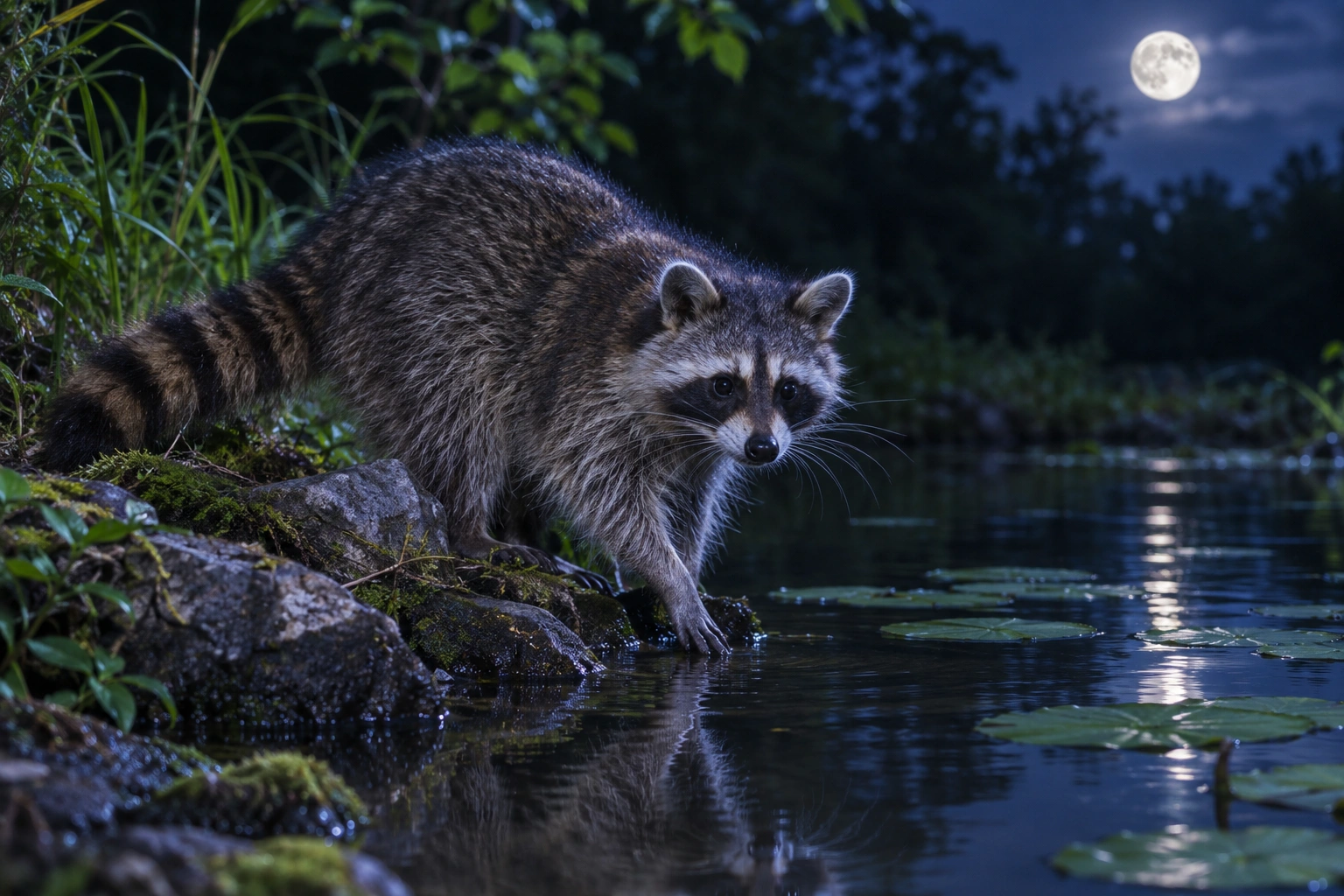
- Wildlife watchers who want to see true colors of foxes, raccoons, bobcats and birds.
- Backyard and farm users identifying pests or predators near livestock and gardens.
- Security use, where color helps identify people, clothing and vehicles.
- Hunters doing a summer inventory, where spooking is less of a concern.
For hunting-season cameras on mature bucks, a no-glow IR camera is usually the safer choice, even though night photos are black and white.
Night Camera Types Compared
| Type | Night photos | Range | Spooks deer? | Best for |
|---|---|---|---|---|
| Low-glow IR (850nm) | Black and white | Longest of the IR types | Faint red glow; some deer notice | Most hunting and scouting |
| No-glow IR (940nm) | Black and white, often darker | Shorter | Hardest to see | Pressured deer, security |
| White flash | Full color, sharp | Medium | Yes, often | Wildlife photos, research |
| Starlight / low-light sensor | Color in dim light, no flash | Short; needs some light | No flash, so little reaction | Backyards, lit areas, moonlit fields |
Performance varies a lot by model. Some low-light cameras switch to black and white IR when it gets too dark for color.
Step-by-Step: Getting Good Color Night Photos
- Choose the right spot. For starlight cameras, pick a place with some light: moonlit openings, field edges, or near a yard light.
- Keep animals close. Color night cameras work best at short range, often within about 20 to 30 feet.
- Avoid busy backgrounds that turn into noise in low light. A plain background helps.
- Use fresh lithium batteries, since white flash cameras use a lot of power.
- Test at night before you leave the camera for a week.
- Check results by moon phase. Starlight photos are often much better on bright moon nights.
Does White Flash Really Spook Deer?
Many hunters report that deer react to a white flash: they jump, stare or avoid the spot, especially mature bucks. Others see deer that seem to get used to it over time, particularly does and young deer at feeders. Reactions depend on the deer, the area and how much pressure they feel. If you are hunting a specific buck, a white flash camera on his main trail is a risk most hunters avoid. For backyard wildlife and research, it is usually fine. See can deer see trail camera flash.
Field Examples
The backyard wildlife fan: a starlight camera near a porch light gives beautiful color video of foxes, raccoons and deer, which a standard IR camera would show in black and white.
The deer hunter: a white flash camera on a scrape gets great color photos for two nights, then the buck stops coming in daylight and shows up only from a different direction. Switching to a no-glow camera brings him back into view.
The dark woods: a starlight camera in thick timber on a cloudy, moonless night returns mostly black or very noisy photos. Without some light, color night vision has little to work with.
Mistakes With Color Night Cameras
- Expecting daylight color in total darkness. Starlight sensors need some ambient light.
- Using white flash on pressured bucks. You may push the deer you want to see.
- Setting the camera too far away. Color night range is short compared with IR.
- Ignoring battery drain. White flash and long color videos use a lot of power.
- Forgetting security. A white flash is visible to people from a long way off, so it is a poor choice where theft is a risk.
Who Should Stick With Black and White
For most deer hunters, black and white infrared is still the best choice. It has longer range, does not spook deer much, and shows enough detail to judge antlers and count deer. Color night vision is a fun upgrade for wildlife watching, backyard cameras and research, but it is not a must-have for scouting.
How Infrared Turns Night Into Black and White
A standard trail camera lights the scene at night with infrared LEDs, which give off light just beyond what our eyes can see. The camera’s sensor can see this light, but infrared has no color information the way visible light does, so the camera records the scene in shades of gray. During the day, a filter blocks infrared so colors look normal. At dusk, the camera moves that filter out of the way and switches to night mode. That is why the change from color to black and white happens at a set light level, and why some dusk photos look oddly washed out. Color night cameras get around this either by adding visible light with a white flash, or by using a very sensitive sensor that can still pick up color from moonlight and other weak light sources.
Tips for Better Night Photos With Any Camera
- Keep animals within the flash range, and well inside it for no-glow cameras.
- Clean the lens and flash cover often. Dust scatters light and adds haze.
- Use fresh lithium batteries so the flash runs at full power.
- Avoid close objects that reflect the flash back, such as branches and tall grass.
- Try your camera’s night mode options, such as long range or fast motion.
For more, see how does a trail camera work at night.
Frequently Asked Questions
Can a trail camera take color pictures at night?
Yes. White flash cameras and cameras with starlight or low-light color sensors can take color photos at night. Standard infrared cameras take black-and-white night photos.
Why are my trail camera night pictures black and white?
Your camera uses infrared light at night. Infrared light does not carry color information, so the sensor saves the image in black and white.
Does a white flash trail camera scare deer?
It can. Deer can see a white flash, and some, especially mature bucks, may avoid the area. Infrared, especially no-glow IR, is much less noticeable.
What is a starlight trail camera?
It is a camera with a very sensitive sensor that records color in dim light such as moonlight, without using a flash. It needs some ambient light to work in color.
Which night vision is best for hunting?
No-glow (black) infrared is usually best for hunting because deer cannot see the flash, even though the photos are black and white.
Do color night vision trail cameras work in total darkness?
Starlight cameras need some light to show color. In total darkness, many switch to black and white infrared or show very dark, noisy images.
Is a white flash trail camera good for security?
Usually not. The bright flash is easy for people to see, which can draw attention to the camera.
What is the best night vision for deer hunting?
For most hunters, low-glow or no-glow infrared. It has good range and is less likely to spook deer than a white flash.