
Why Do Deer Like Salt Blocks? Mineral Sites and Trail Cameras
Put out a salt block or a bag of deer minerals in spring, and within a few weeks you may find a muddy hole in the ground with deer tracks all around it. Deer will dig, lick and even eat the dirt where salt has soaked in. So why do deer like salt blocks, are minerals actually good for them, and what is the best way to use a mineral site with your trail camera?
Deer like salt blocks because they crave sodium. Their spring and summer diet of fresh green plants is high in water and potassium but low in sodium, so deer seek out salt, especially from April to August when bucks grow antlers and does carry and nurse fawns. Mineral mixes add calcium and phosphorus, but the salt is what pulls deer in. A mineral site is one of the best spots for a summer trail camera inventory. Check your state’s rules first, because some states treat salt and minerals as bait.
- What deer want
- Mainly sodium (salt)
- Peak use
- April to August
- Low use
- Fall and winter
- Block vs loose
- Loose mineral or granules soak in faster
- Camera distance
- 10–15 ft, side-on, about 3 ft high
- Legal
- Some states ban minerals as bait
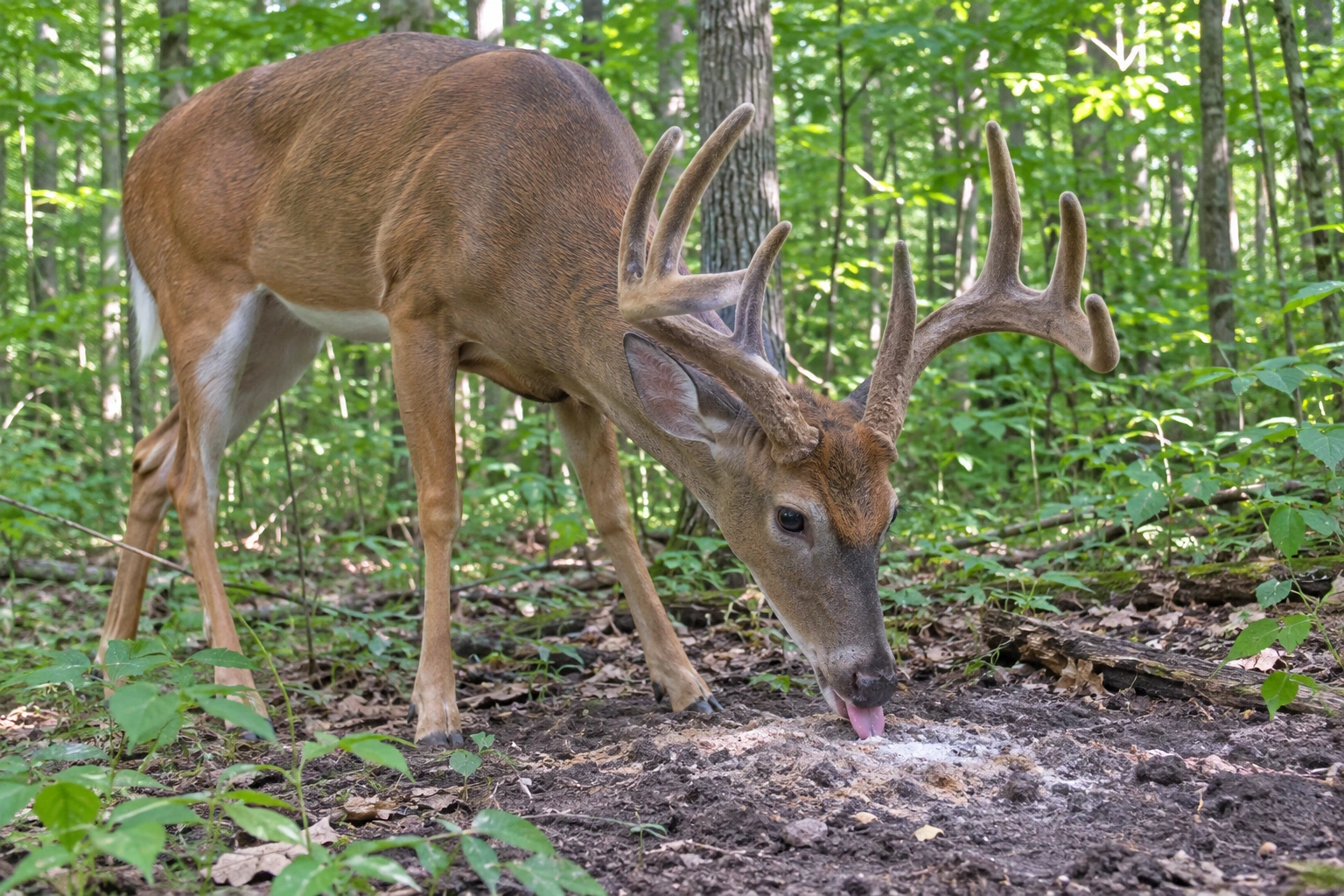
Why Deer Crave Salt and Minerals
The main reason is sodium. In spring, deer switch from dry winter food to fresh, green plants. These plants are full of water and potassium, which makes deer lose sodium faster. Their bodies then crave salt, the same way you might crave a salty snack after a long, hot day.
The craving is strongest when deer need the most from their bodies:
- Bucks are growing antlers, one of the fastest-growing tissues in any animal.
- Does are late in pregnancy and then producing milk for fawns.
- Fawns and yearlings are growing fast.
Natural salt licks, such as mineral-rich soil along creeks or road edges where salt has run off, have pulled in deer and other animals for thousands of years. A salt block or mineral site works the same way.
Salt Blocks vs Mineral Mixes
- Plain salt blocks: cheap and long-lasting. Deer lick them, and over time the rain carries salt into the soil, where deer dig and lick the dirt.
- Loose minerals or granules: poured on the ground or mixed into a stump or hole. They soak into the soil quickly, so deer find and use the site faster. Most contain salt plus calcium, phosphorus and trace minerals.
- Liquid or “attractant” products: often salty with sweet or smoky scents added. They can pull deer in fast but may need refreshing more often.
Do minerals make bigger antlers? Antler size depends mostly on age, genetics and overall food quality. Calcium and phosphorus in a mix may help a little where soils are poor, but there is not strong proof that minerals alone grow bigger racks. The main value of a mineral site for most hunters is getting deer in front of a camera.
Best Season for Mineral Sites
Set up mineral sites in late winter or early spring, around March or April, so the salt soaks in before peak season. Use peaks in May through August. July and August are the best months for a buck inventory, since antlers are well grown and still in velvet. In September, as acorns drop and the rut approaches, deer use mineral sites far less. By November most deer ignore them.
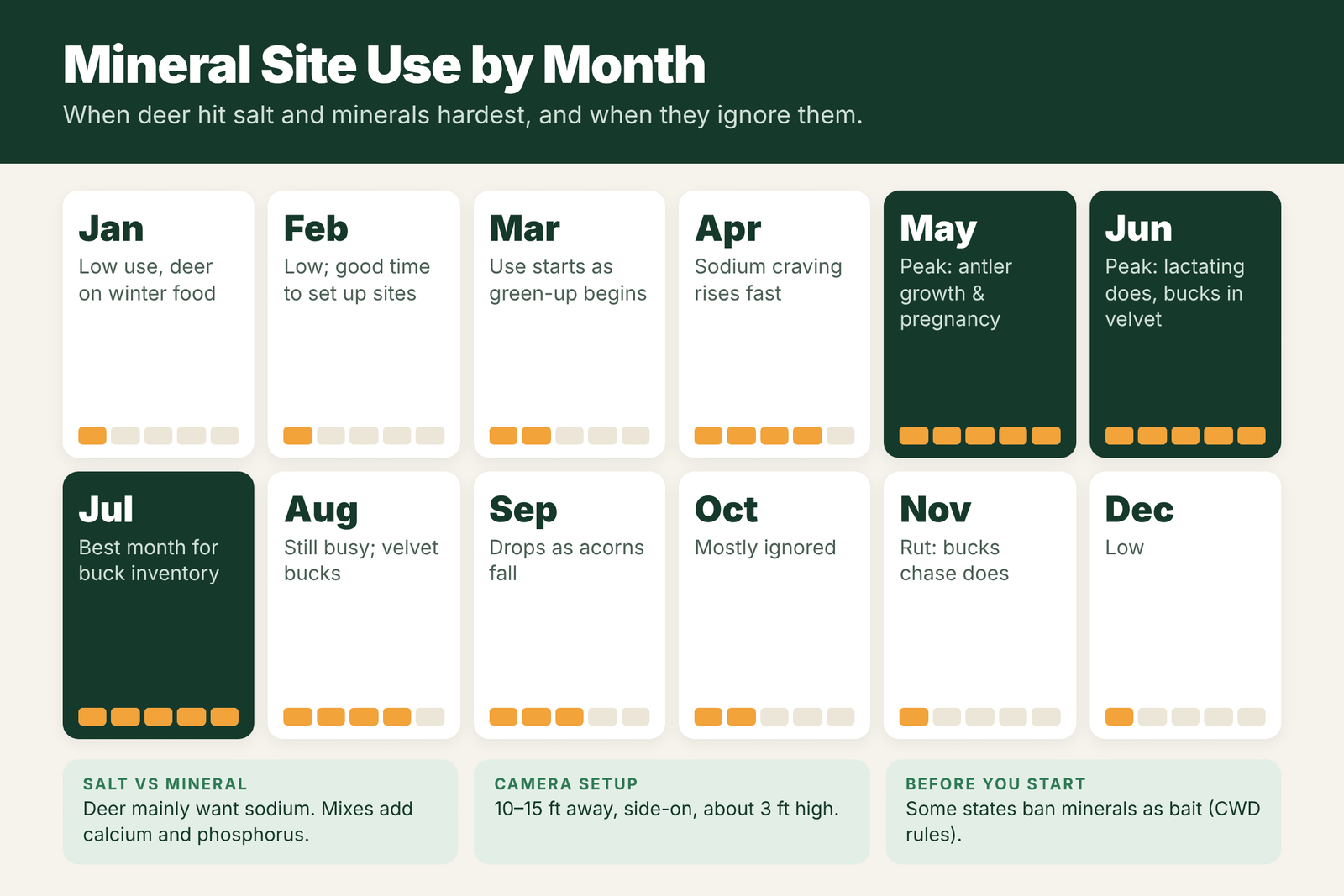
How to Set Up a Trail Camera on a Mineral Lick
- Pick a spot deer already use: a trail junction, field edge or near bedding cover, with a tree for the camera.
- Put out the mineral in a patch about 2–3 feet wide. Rake the soil first so it soaks in. On a slope, put it on the uphill side so the salt runs down into the dirt.
- Mount the camera 10–15 feet away at about 3 feet high, angled so deer stand broadside to it. Face it north if you can to avoid sun glare.
- Settings: photo burst of 3 shots, or short video clips, with a 1–5 minute delay. Deer can stay at a mineral site for a long time, so a longer delay saves battery and storage.
- Refresh the mineral every month or two in summer.
- Clear the view of tall weeds that grow fast in summer and cause false triggers.
Our guides on how to attract deer to a trail camera and whether to put bait in front of your trail camera cover more options.
Legal Rules on Salt, Minerals and Baiting
Laws differ a lot from state to state, and even by county. Some states allow salt and minerals year-round, some allow them only outside hunting season, and some ban them completely, often because of chronic wasting disease (CWD). Concentrating deer at one spot can help diseases spread. Before you put out salt or minerals:
- Check your state wildlife agency’s rules on baiting and feeding.
- Check whether a former mineral site counts as “baited” for hunting purposes. In some states, the soil stays salty and the area can still be considered baited for a while after the block is gone.
- Watch for CWD management zones, which often have stricter rules.
Other Animals at Mineral Sites
Do not be surprised to see more than deer. Elk, moose, rabbits, squirrels, porcupines, bears, and even cattle and horses love salt. In bear country, a mineral site can attract bears, so place it away from campsites and cabins.
Want to make your own attractant? See how to make the best deer attractant.
How to Start a Mineral Site: Step by Step
Where it is legal, a mineral site is easy to set up and can draw deer for years. Here is a simple approach many hunters use.
- Pick the spot. Choose a place near bedding cover or along a travel trail, in a little shade, and away from roads and neighbors’ lines. Low, damp ground holds minerals in the soil well.
- Clear and loosen the ground. Rake away leaves and break up a patch of soil about 3 to 4 feet across.
- Add the mineral. Pour a loose mix into the soil, or set a block on a stump or flat rock. Loose mixes soak into the dirt quickly, which deer then lick and paw.
- Let rain do the work. Deer often find a new site within days to a few weeks, faster after a rain soaks minerals into the ground.
- Refresh it. Add more in early spring and again in summer. Old sites keep pulling deer because the soil stays salty.
- Hang the camera before deer start using it heavily, so you do not disturb an active site later.
Salt Block vs Loose Mineral vs Liquid
| Type | Pros | Cons | Best for |
|---|---|---|---|
| Salt block | Cheap, lasts a long time, easy to carry | Slow to soak in; can be licked by livestock | Long-term spots you visit rarely |
| Loose mineral mix | Fast attraction, soaks into soil | Washes away; needs refreshing | Summer camera inventory |
| Liquid or spray | Very fast attraction | Short-lived | Quick setups, checking a new area |
| Natural lick (existing) | Deer already use it | Location is fixed | Hunting where minerals are banned (check rules) |
Trail Camera Setup at a Mineral Lick
- Distance: about 8 to 12 feet from the lick, so deer fill the frame but the flash does not wash them out.
- Height: about 3 to 4 feet, angled slightly down, to catch antlers when deer lower their heads.
- Mode: burst of 3 photos or short videos. Deer often stand at a lick for minutes, so a 1 to 5 minute delay keeps your card from filling up.
- Direction: face north or south to avoid sun glare.
- Check rarely: every two weeks in summer is plenty. Bucks in velvet are often comfortable at mineral sites in daylight, so do not ruin it.
What Your Mineral Site Photos Can Tell You
A summer mineral site is one of the best places to take a buck inventory. Within a few weeks, you can often count how many different bucks use the area, judge their age and antler growth, and see how many fawns made it through spring. Save the best photo of each buck by date. When velvet comes off in late August and September, many bucks shift their routines, and mineral site visits may drop as acorns and crops ripen. That change is normal, so move cameras toward food and trails in the fall.
Common Mistakes
- Putting minerals out during hunting season where it counts as baiting. Know your state’s rules and how long a site counts as baited.
- Placing a site right next to your stand. If it is illegal to hunt over, it can also get you in trouble or ruin a stand location.
- Using only plain white salt and expecting antler miracles. Salt draws deer, but antler size depends far more on age, genetics and overall food quality.
- Ignoring disease risk. In CWD areas, many agencies discourage anything that concentrates deer.
Field Example: A Summer Mineral Site
A hunter puts loose mineral on a damp bench near a thicket in early May. Within ten days, does are visiting every evening. By late June, the camera shows six different bucks in velvet, mostly between 8 p.m. and midnight, with two coming in daylight on cool, rainy evenings. The hunter saves one photo of each buck every two weeks and tracks their growth. In September, visits drop as acorns fall, so the camera moves to a nearby oak flat. The mineral site did its job: it showed what bucks live there before the season starts.
Frequently Asked Questions
Why do deer like salt blocks?
Deer crave sodium. Their spring and summer diet of green plants is low in sodium and high in potassium, so they seek out salt, especially while bucks grow antlers and does carry and nurse fawns.
Do salt blocks attract deer?
Yes, especially from April to August. Deer often lick the block and dig into the salty soil around it. In fall and winter, they use salt much less.
When should I put out a salt block for deer?
Late winter or early spring, so the salt soaks into the ground before peak use from May through August.
Are salt blocks good for deer?
Salt helps deer meet a natural need for sodium. However, concentrating deer at one spot can help spread disease, so follow your state’s rules, especially in CWD areas.
Is it legal to put out salt for deer?
It depends on your state and sometimes your county. Some states allow it, some only outside hunting season, and some ban it as baiting. Always check your state wildlife agency’s rules.
How long does it take deer to find a salt block?
Often a few days to a few weeks. Rain speeds it up by soaking salt into the soil.
Where is the best place to put a salt block for deer?
Near bedding cover or a travel trail, in light shade, away from roads, and in a spot where it is legal.
How far should a trail camera be from a mineral lick?
About 8 to 12 feet, at 3 to 4 feet high and angled slightly down.