
Deer Bedding Areas: How to Find Them With Trail Cameras
If you know where deer bed, you know where they start and end their day. That makes a deer bedding area one of the most valuable things you can find on your property. It tells you which way deer travel, where to hang stands and trail cameras, and where you should never walk. The trick is finding bedding areas without pushing the deer out of them. Here is how to do it with maps, a little scouting, and your trail cameras.
Deer bed in thick cover close to food, often on the downwind edge of a thicket or just below the crest of a ridge or point, where the wind brings them scent from behind and they can see ahead. Look for oval, matted spots in grass or leaves, about 3–5 feet long, with droppings and hair nearby. Use aerial maps to find thick cover and terrain features, confirm with late-winter scouting, then put trail cameras on the trails leading in and out, never inside the bedding area itself.
- What a bed looks like
- Oval, matted, about 3–5 ft long
- Doe beds
- Groups of beds, closer to food
- Buck beds
- Single, larger, on points and edges
- Wind
- Bucks bed with the wind at their back
- Best time to scout
- Late winter or early spring
- Cameras
- On entry and exit trails, not in beds
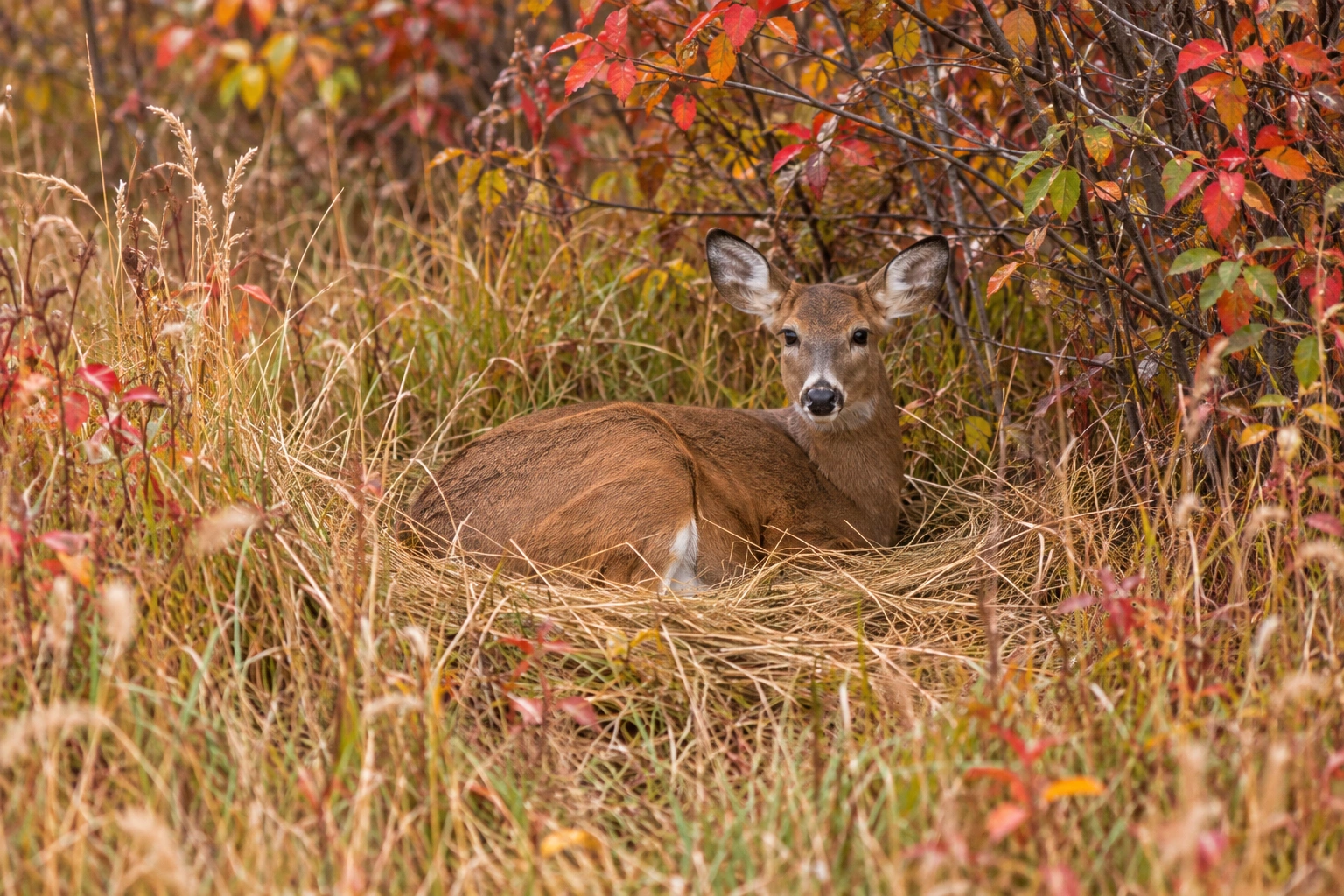
What a Deer Bed Looks Like
A deer bed is a spot where a deer has lain down, pressing the grass, leaves or snow flat. Signs to look for:
- Shape and size: an oval, about 3 to 5 feet long and 2 to 3 feet wide. Bigger beds usually mean bigger deer.
- Matted grass or leaves, sometimes scraped down to bare dirt in a well-used spot.
- Melted ovals in snow in winter, which are the easiest beds to spot.
- Droppings and hair close by. Deer often get up and relieve themselves near their bed.
- Trails leading in and out, and sometimes small rubs near buck beds.
Deer usually spend most of the daylight hours bedded. Read more about their daily routine in where deer go during the day.
Buck vs Doe Bedding
- Does and fawns often bed together, so you will find several beds in one small area. Doe bedding tends to be closer to food and in slightly less thick cover.
- Mature bucks usually bed alone. Their beds are larger and are often in thicker cover or on spots with a clear advantage: the end of a point, just below a ridge top, or on a small rise in a swamp. You may find a rub or two close to the bed.
- In the rut, bucks bed near doe bedding areas, often downwind, so they can smell when a doe comes into heat.
Map and Terrain Clues
You can find likely bedding areas before you set foot in the woods. Open an aerial or topo map app and look for:
- Thick cover: darker, rough-looking patches on aerial photos, such as young timber, cedar stands, clear-cuts growing back, and CRP fields.
- Points and ridges: fingers of high ground that drop toward a creek or field. Bucks love to bed near the end.
- Benches: flat shelves on the side of a hill, often about two-thirds of the way up.
- The leeward side of ridges: the side out of the main wind, especially in cold weather.
- Islands of high ground in swamps and thick creek bottoms.
- Small, overlooked cover near roads, houses or field corners, where hunters rarely go.
Then look at how this cover connects to food. Bedding areas usually sit within a few hundred yards of the main food sources, with trails or funnels between them.
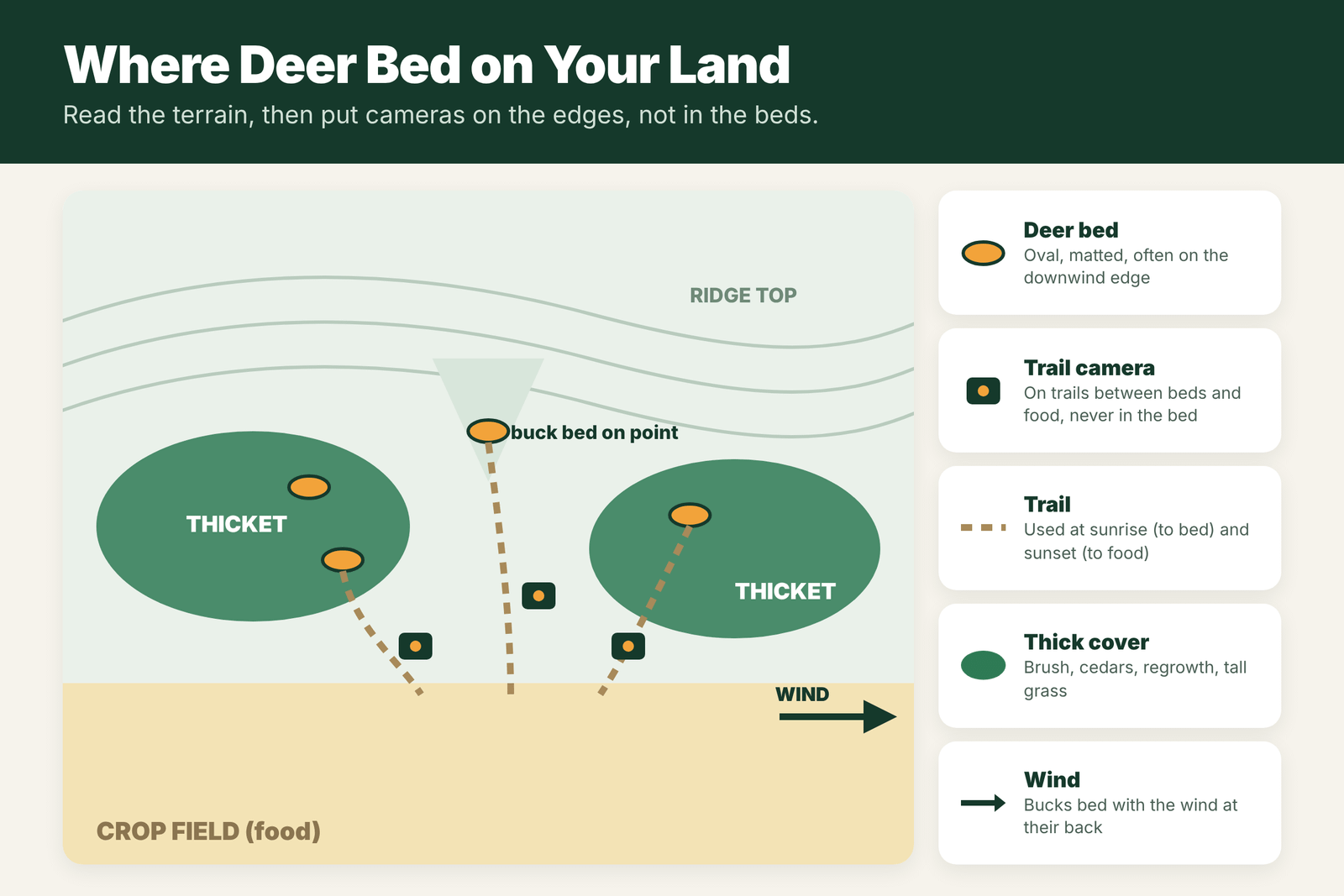
Where to Put Trail Cameras Near (Not In) Beds
Walking into a bedding area during the season, or hanging a camera inside it, is the fastest way to push deer off your land. Instead:
- Put cameras on entry and exit trails where they leave thick cover toward food.
- Use staging areas: small openings or edges in cover near the field where deer stand around before going out at dusk.
- Watch funnels between two bedding areas, especially in the rut, when bucks cruise from one doe bedding area to another.
- Use cellular cameras near bedding so you never walk in to check them.
- Hang cameras at mid-day with the wind blowing from the bedding area toward you.
Read our guides on where to place trail cameras and how to place a trail camera in the woods for setup details.
Confirming Beds With Camera Data
- Morning photos heading into cover and evening photos coming out confirm a bedding area in that direction.
- Daylight photos close to cover show where deer feel safe in shooting light. These spots make good stand sites.
- The same buck at dawn on one camera and at dusk on another tells you his route between bed and food.
Creating Bedding Habitat
If your land is short on thick cover, you can make more:
- Hinge-cut trees: cut small trees partly through so they fall but keep living, creating thick, low cover fast (check local rules and safety first).
- Plant native grasses like switchgrass in field edges or corners.
- Let areas grow up: leave old fields or clear-cuts alone to turn into thick young growth.
- Plant conifers like spruce or cedar for winter cover.
- Make sanctuaries: mark some cover as off-limits all season.
See how to make the best deer habitat for more ideas.
Bedding Area Types Compared
Deer use different kinds of cover depending on the land, the season and how much pressure they feel. Here are the most common types and how to approach each one.
| Bedding type | Why deer use it | How to set up nearby |
|---|---|---|
| Brushy thicket or clearcut regrowth | Thick cover, food close by | Cameras on trails at the edge, stands on the downwind side |
| Ridge point or bench | Wind at the back, view ahead | Cameras on the trail below the point |
| Swamp or cattail island | Hard for people to reach | Cameras on dry-ground entry trails |
| CRP or tall grass field | Cover in open country | Cameras at fence crossings and field corners |
| Conifer stand | Shelter from wind and snow | Cameras on winter trails to food |
| South-facing slope | Warm in winter sun | Late-season cameras near food on the slope |
Step-by-Step: Finding Beds Without Spooking Deer
- Start on the map. Look for thick cover on aerial photos, plus terrain features like points, benches, saddles and creek bends.
- Mark likely spots and wind. Deer like beds where the wind carries scent from behind and they can see or hear ahead.
- Scout in late winter or early spring. The leaves are down, deer sign is easy to see, and pressure has less effect on the coming season.
- Walk the edges first. Find trails, rubs and droppings leading in and out, then go in only after the season.
- Look for clusters of beds. Several oval beds together usually mean a doe group. A single bed with big rubs nearby can mean a buck.
- Place cameras on entry and exit trails, 50 to 150 yards from the cover, and leave them alone.
Camera Settings for Bedding-Area Trails
- Cellular is best: you can check photos without walking in and leaving scent.
- Mount higher and angle down (about 6 to 7 feet) so deer coming in nervous do not stare at the camera at eye level.
- No-glow flash for night photos near beds.
- Burst of 2 to 3 photos and a short delay, since deer often move quickly in and out of cover.
- Note times carefully: deer passing in the first and last hour of light suggest a bed is close.
Mistakes Near Bedding Areas
- Checking cameras inside the cover. This is the fastest way to push deer to a new spot.
- Hunting a bedding stand on the wrong wind. If your scent drifts into the beds, deer will leave and may not come back for days.
- Overhunting one stand. A great bedding stand should be saved for the right wind and a few key days, often in the rut.
- Creating noisy access. Clear a quiet path to your stand ahead of time, and use creeks, ditches or field edges to stay hidden.
Field Example
A hunter finds a thick clearcut on the map with a crop field 300 yards away. Cameras on the field show does every evening but a mature buck only at night. The hunter moves one cellular camera to a trail on the downwind edge of the clearcut, 80 yards from the cover. Within two weeks, the buck shows up there 15 minutes before dark on cool evenings with a northwest wind. That is the stand: on the edge, on the right wind, used only on those days.
How Beds Change With the Season
In early fall, deer often bed in cool, shady cover close to food and water. During the rut, bucks may bed downwind of doe groups so they can scent-check them, and does get pushed around more. After the rut and into winter, deer shift toward south-facing slopes, conifers and thick cover out of the wind, close to the best remaining food. A camera on a bedding trail in October may go quiet in December simply because the deer moved to their winter beds, so follow the food and the weather, not just last month’s photos.
Frequently Asked Questions
What does a deer bedding area look like?
A deer bedding area is a patch of thick cover with several oval, matted spots in the grass, leaves or snow, about 3 to 5 feet long, often with droppings, hair and trails nearby.
Where do bucks bed?
Mature bucks often bed alone on points, just below the top of ridges, on benches or on high spots in swamps, with the wind at their back and a view in front.
Should I put a trail camera in a bedding area?
No. Put cameras on trails leading in and out of the bedding area and at staging areas near food. Going into the bedding area can push deer away.
When is the best time to scout for deer beds?
Late winter or early spring, after hunting season. Deer will not be pushed off before the season, and beds and trails are easy to see with the leaves down.
How far do deer bed from food?
Often within a few hundred yards, though it varies with cover and pressure. Heavily pressured deer may bed farther away in thicker cover.
How big is a deer bedding area?
It varies. A doe group may bed in a few acres of thick cover, while a buck may use a small spot of under an acre.
Do deer use the same bedding area every day?
Often, but they rotate between several beds based on wind, weather, season and pressure.
Should I hunt right in a deer bedding area?
Usually not. Hunt the edges and trails leading in and out, on a wind that keeps your scent away from the beds.