
Trail Camera Deer Survey: How to Count and Age Your Herd
How many deer live on your land? How many are bucks, and how old are they? Are enough fawns surviving? Most hunters guess. A game camera deer survey lets you answer these questions with real numbers using the trail cameras you already own. It is the same basic method many wildlife biologists and land managers use, and it takes about three weeks.
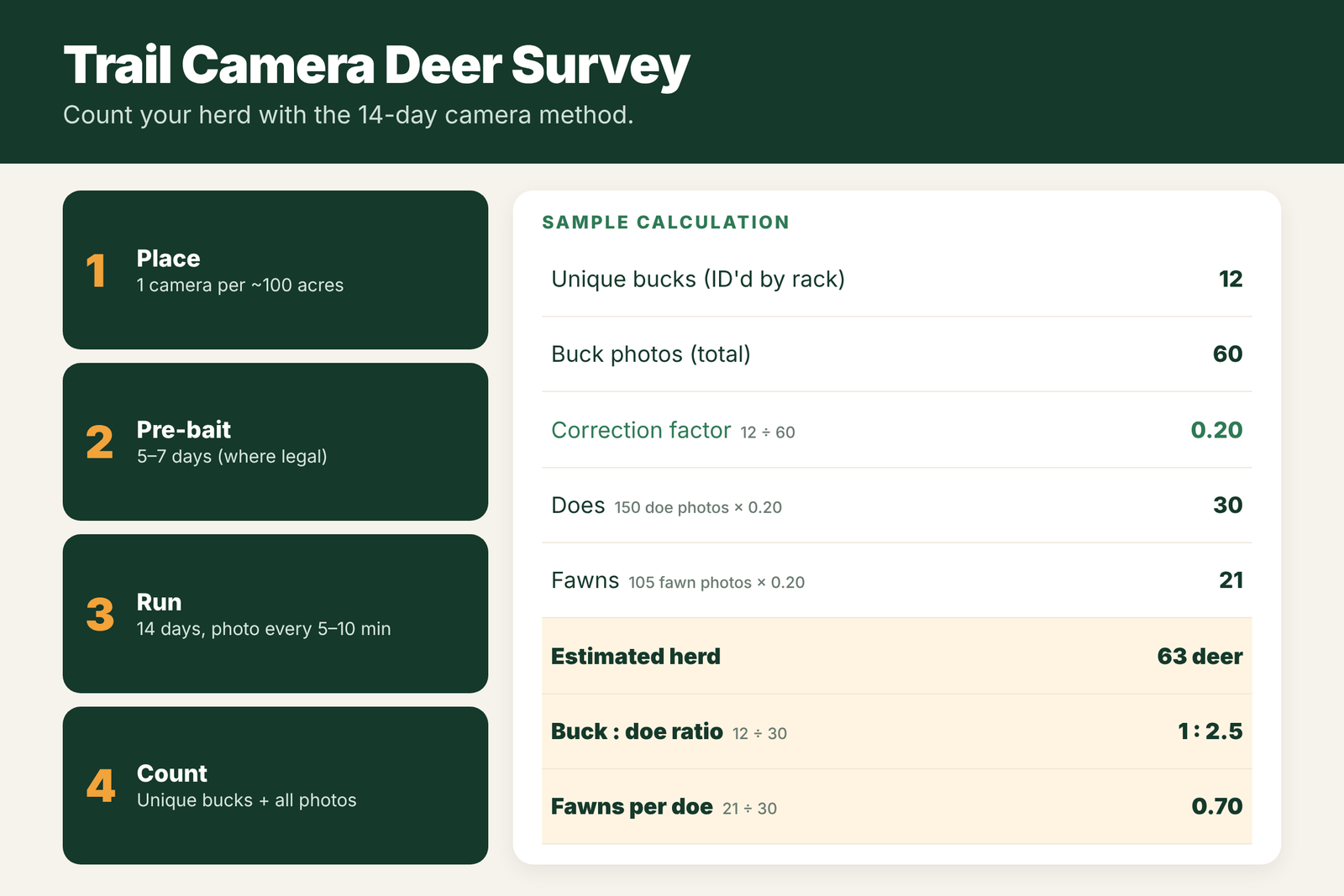
Put out about one camera per 100 acres at bait or mineral sites (where legal). Pre-bait for 5–7 days, then run the cameras for 14 days on photo mode with a 5–10 minute delay. Count every unique buck by his antlers and count all buck, doe and fawn photos. Divide unique bucks by total buck photos to get a correction factor, then multiply doe and fawn photos by it. That gives you an estimate of bucks, does, fawns, your buck-to-doe ratio and fawns per doe.
- Cameras
- About 1 per 100 acres
- Pre-bait
- 5–7 days before counting (where legal)
- Survey length
- 14 days
- Camera setting
- Photo mode, 5–10 minute delay
- Best timing
- Late summer (Aug–Sep) or right after season
- Key results
- Herd size, buck:doe ratio, fawns per doe
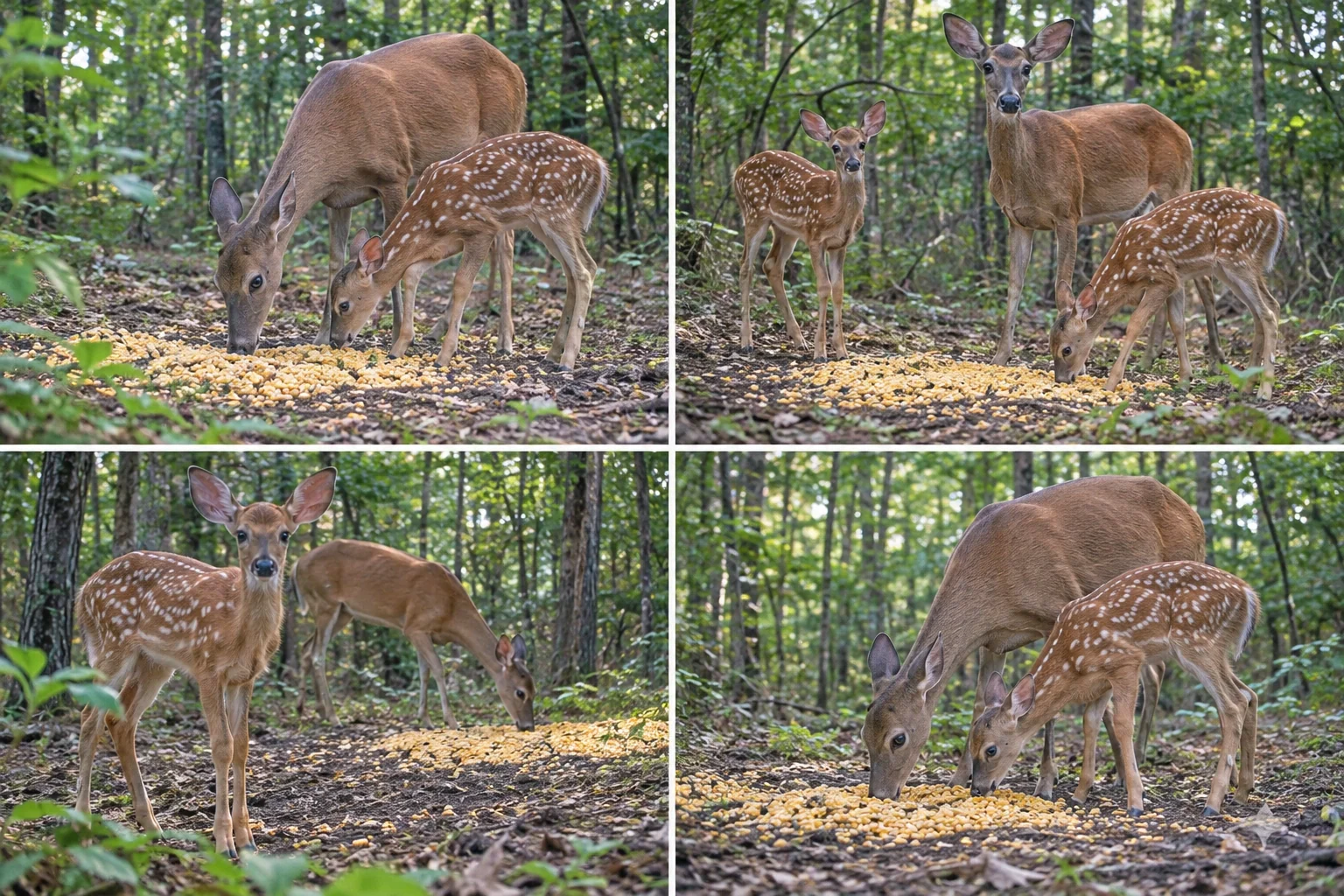
Why Run a Trail Camera Deer Survey?
A survey turns your camera photos into numbers you can act on:
- Herd size: are there too many deer for your habitat, or too few?
- Buck-to-doe ratio: a herd with many more does than bucks often has a longer, less intense rut and fewer mature bucks.
- Buck age structure: how many young bucks you have compared to 3.5- and 4.5-year-olds.
- Fawn recruitment: how many fawns per doe survive to fall. Low numbers can point to predators or poor habitat.
- Harvest plans: how many does to take, and which bucks to let walk.
Run the survey every year at the same time and in the same way, and you can see the trend, which is even more useful than one year’s numbers.
How Many Cameras and Where to Put Them
The standard method uses about one camera per 100 acres. On a 300-acre property, that means three cameras. More cameras are fine, but fewer than that can miss deer. Our guide on how many trail cameras per acre covers this in more detail.
- Spread them out so each camera covers its own block of about 100 acres.
- Pick spots deer already use: trail junctions, field edges, near bedding cover.
- Use bait or a mineral site to pull deer in front of the camera, where this is legal. Some states ban baiting or limit it because of chronic wasting disease (CWD). In those areas, use natural food sources and trails. See should I put bait in front of my trail camera for the pros and cons.
- Set the camera 10–15 feet from the bait and about 3 feet high, facing north, so you get sharp, side-on photos for IDs.
The 14-Day Survey Method
- Pre-bait for 5–7 days. Put out bait so deer find it and start visiting. Do not count these photos.
- Set the cameras for the survey. Use photo mode and a 5–10 minute delay (some guides use a timed photo every 5 minutes). This keeps one deer from filling the card with hundreds of photos.
- Run the cameras for 14 days. Keep the bait topped up so it never runs out. Check cameras as little as possible, at mid-day.
- Pull the cards and sort the photos into bucks, does and fawns.
The best times to run a survey are late summer (August to early September), when bucks have grown most of their antlers and fawns have lost most of their spots, or right after hunting season, before bucks drop their antlers.
Counting Bucks, Does and Fawns
This is where the method gets clever. You can tell bucks apart by their antlers, but most does and fawns look the same. So you count the bucks exactly and use them to estimate the rest.
- Count the unique bucks. Go through every buck photo and identify each different buck by his rack. Give each one a name or number. Example: 12 unique bucks.
- Count all buck photos. Count every photo with a buck in it (count each buck in a group photo). Example: 60 buck photos.
- Work out the correction factor. Unique bucks ÷ buck photos. Example: 12 ÷ 60 = 0.20. This tells you how many times, on average, each deer was photographed.
- Count all doe photos and all fawn photos, the same way. Example: 150 doe photos and 105 fawn photos.
- Multiply by the correction factor. Does: 150 × 0.20 = 30 does. Fawns: 105 × 0.20 = 21 fawns.
So in this example, the estimated herd is 12 bucks + 30 does + 21 fawns = 63 deer. It is an estimate, not an exact count, but if you do it the same way every year it is a very good guide.
Calculating Buck-to-Doe Ratio and Fawn Recruitment
- Buck-to-doe ratio = bucks ÷ does. In the example: 12 ÷ 30 = 0.4, or 1 buck to 2.5 does. Many managers aim for closer to 1:1 to 1:2 on properties managed for mature bucks.
- Fawns per doe (fawn recruitment) = fawns ÷ does. In the example: 21 ÷ 30 = 0.70. Lower numbers, especially below about 0.5, can mean heavy predation or poor habitat.
- Buck age classes: sort your unique bucks into age groups (1.5, 2.5, 3.5, 4.5+) by body shape. Young bucks look leggy with thin necks. Mature bucks have deep chests, thick necks and sagging bellies. Our guide on how to score a deer helps you size up racks too.
Using the Results for Harvest Decisions
- Too many does for the habitat or a wide buck-to-doe ratio: increase doe harvest.
- Few fawns per doe: hold back on doe harvest and look at predator control and fawning cover.
- Lots of young bucks, few mature ones: pass on young bucks so more reach 3.5 years or older.
- Herd looks healthy and balanced: keep the same plan and run the survey again next year to watch the trend.
Once you know which bucks you have, the next step is learning their habits. Our guide on how to pattern a mature buck with trail cameras shows how.
Frequently Asked Questions
How do you do a deer survey with trail cameras?
Place about one camera per 100 acres at bait or mineral sites where legal, pre-bait for 5 to 7 days, then run the cameras for 14 days. Count unique bucks and all photos, then use the buck numbers to estimate does and fawns.
How many trail cameras do I need for a deer survey?
About one camera per 100 acres is the standard. A 300-acre property needs about three cameras spread out so each covers its own area.
How do you calculate buck to doe ratio from trail camera photos?
Count unique bucks, then divide that by total buck photos to get a correction factor. Multiply doe photos by the factor to estimate does. Divide bucks by does for the ratio.
When is the best time to do a trail camera deer survey?
Late summer, in August or early September, when bucks have most of their antlers, or right after hunting season before bucks shed their antlers.
Can I do a deer survey without bait?
Yes. Where baiting is not allowed, put cameras on busy trails, food sources and field edges. The results are less precise, but they still show trends if you repeat the survey the same way each year.