
Bobcat on Trail Camera: How to Identify, Find, and Photograph Bobcats
Some animals show up on your trail camera every night. Bobcats are not one of them. You can run cameras for months and get nothing, then one morning there it is: a spotted cat with tufted ears and a stubby tail, frozen mid-step in the infrared glow. It is one of the best feelings in trail camera scouting.
Bobcats are common across much of North America, but they are quiet, solitary, and mostly active at night, so most people never see one in person. A trail camera is the best way to learn where they travel. This guide covers how to identify bobcats in your photos, where to look for them, and how to set your cameras for clearer, more frequent bobcat pictures.
Quick answer: Bobcats travel field edges, creek banks, ledges, and thick cover, often in the same places as their rabbit and rodent prey. Put a camera low on these routes, use burst mode or video, and be patient. Tracking in snow or mud is the fastest way to find a spot they use.
How to Identify a Bobcat on Camera
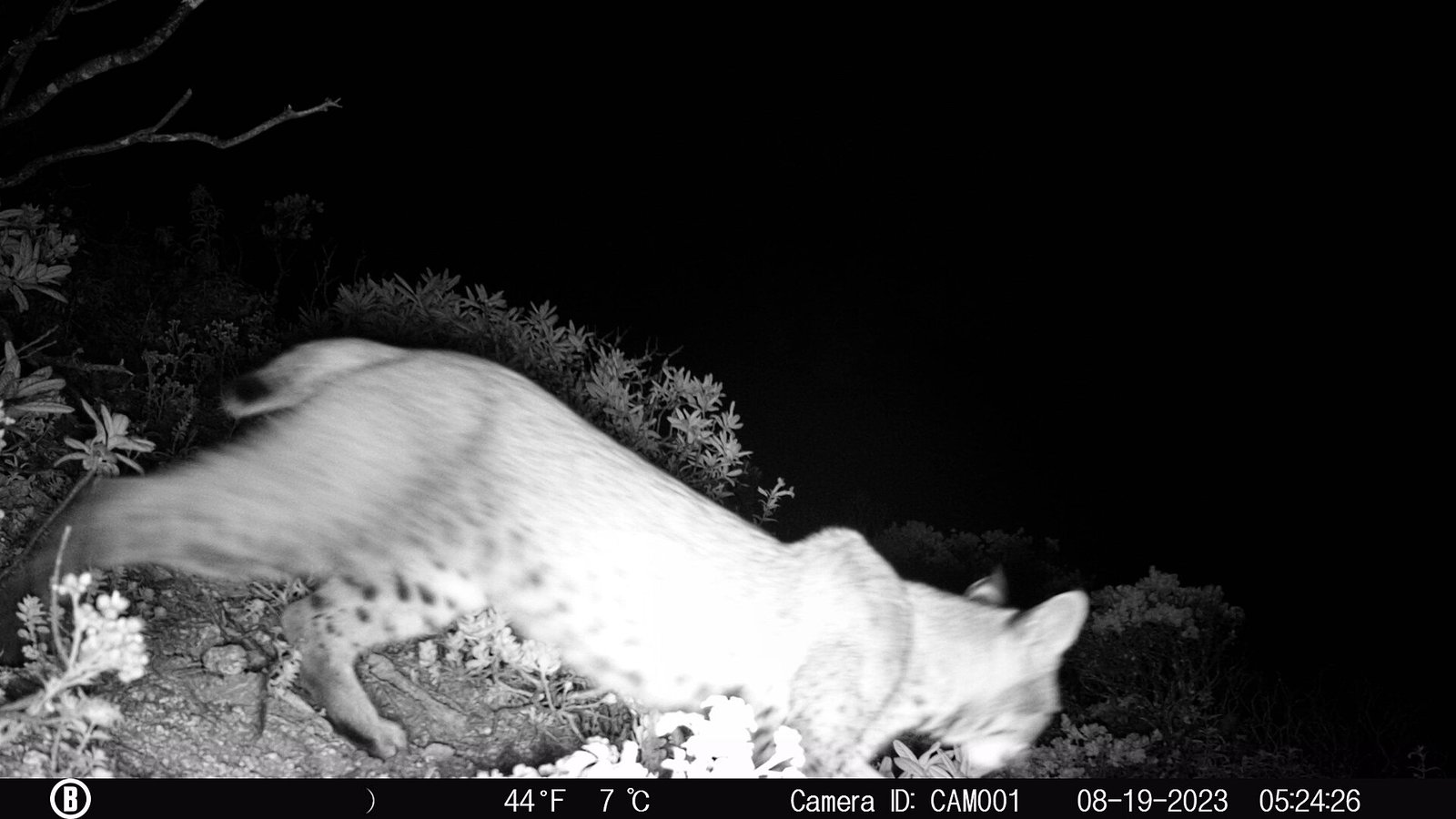
Blurry night photos make ID tricky. Bobcats get confused with house cats, foxes, and occasionally mountain lions. Look for:
- Short, bobbed tail: usually only a few inches long, with a black tip on top and white underneath. This is the giveaway.
- Size: roughly twice the size of a large house cat, with long legs.
- Ear tufts and cheek ruffs that make the face look wide.
- Spots and bars on the legs and belly, though infrared photos often wash these out.
- Bouncy gait: the back legs are long, giving a slightly rabbit-like posture.
Long, thick tail almost as long as the body? That is a cougar, not a bobcat. See mountain lion on trail camera.
Where Bobcats Travel
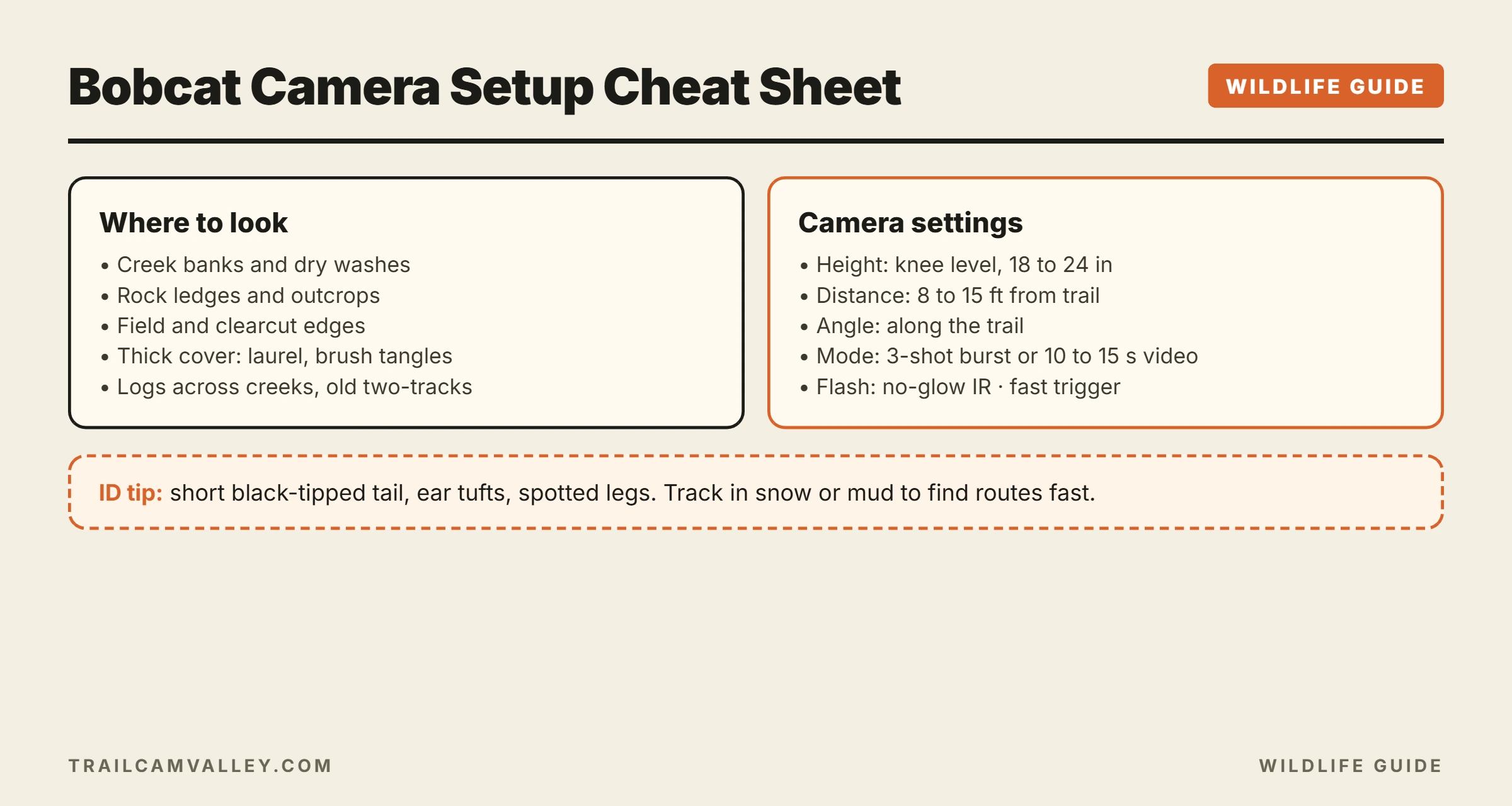
Bobcats are creatures of edges and cover. Northern Woodlands notes that cats use field edges and riparian zones, the banks of rivers and streams, as travel corridors, and that they are fond of ledges. Good camera spots include:
- Creek banks and dry washes
- Rock ledges, outcrops, and talus slopes
- Field and clearcut edges where rabbits and rodents feed
- Thick cover such as rhododendron, laurel, or brush tangles
- Old logging roads and two-tracks
- Logs across creeks and natural bridges that funnel travel
That thick cover point matters. A writer for Raydient’s Rethink Rural got a first bobcat photo only after moving a camera to look under rhododendrons instead of along an open trail. The cat was slinking through the cover at night, right in front of the lens.
Find Their Routes First: Tracking
The fastest path to bobcat photos is finding where an individual cat already goes. Northern Woodlands advises tracking in winter, because tracks show where cats hunt or pass regularly. Look for:
- Round tracks about two inches wide, with no claw marks, often in a neat line
- Scrapes and scat at trail junctions, which bobcats often cover like house cats
- Repeated sets of tracks along the same ledge or creek
Routes can shift with the seasons, but once you know a cat’s habits, your odds improve a lot.
Camera Setup for Bobcats
| Setting | Recommendation | Why |
|---|---|---|
| Height | Knee height, about 18 to 24 inches | Bobcats are low to the ground |
| Distance | 8 to 15 feet from the trail | Sharper detail on a small animal |
| Angle | Along the trail, slightly angled | More time to trigger |
| Mode | 3-shot burst or 10 to 15 second video | Fast-moving cats often leave the frame |
| Flash | No-glow or low-glow IR | Less disturbance at night |
| Trigger | Fast, 0.5 seconds or less | Bobcats move quickly |
Need help with height and angle? See how to aim a trail camera and best trail camera height.
Should You Use Lures?
Lures such as visual attractants or cat-specific scent can bring a bobcat closer, but use them thoughtfully. Northern Woodlands warns against drawing a cat away from its home ground into harm’s way, and suggests placing any lure along the animal’s usual route and well away from human activity. Check local rules too, since luring predators is regulated in some places. Many photographers find that skipping bait forces them to learn the land, which leads to more natural photos.
What Bobcats Tell You About Your Property
A bobcat on camera means healthy prey populations of rabbits, squirrels, and rodents. Bobcats sometimes take turkeys, fawns, and poultry, so landowners with chickens should secure coops at night. Most of the time, a bobcat is simply a sign of a working ecosystem.
Be Patient
Northern Woodlands puts it plainly: you can do everything right and still go months or years without getting a bobcat on camera. Give a spot at least several weeks, check cameras less often to avoid leaving scent, and use a cellular camera if you want to monitor without walking in. Our guide on how often to check a trail camera covers the balance.
Common Bobcat Camera Mistakes
- Mounting too high. A camera at deer height often shoots over a bobcat’s back, especially at close range. Drop it to knee height.
- Watching wide-open trails only. Bobcats like cover. A camera that only watches a wide two-track may miss cats moving along the brushy edge beside it.
- Checking too often. Frequent visits leave scent and disturb the area. Give a spot weeks, not days.
- Single-photo mode. A bobcat can cross the frame in a second. Burst or video gives you a far better chance at a clear image.
- Giving up too soon. A cat may pass a given spot only occasionally. Patience is part of the method.
Bobcats Through the Seasons
Bobcat movement changes over the year. In winter, fresh snow makes tracking easy and shows you exactly where cats travel. In late winter and early spring, during the breeding season, bobcats often move more and cover more ground, which can mean more photos. In summer, females with kittens may stay closer to den areas, and thick vegetation makes cats harder to spot. Adjust camera locations as you learn each season’s patterns, and keep notes on dates and spots where you get photos so you can return next year.
Bobcats and Your Other Wildlife
A bobcat on camera often goes hand in hand with other predator activity. Coyotes, foxes, and bobcats may all use the same creek bottoms and field edges, sometimes on the same night. Keeping a simple log of which predators show up, and when, helps you understand how they share the land. It is also useful for turkey and small-game hunters, since bobcats prey on rabbits, squirrels, and ground-nesting birds. Over time, your cameras can show whether predator activity rises or falls with prey numbers on your property.
Quick Facts
- Cats use field edges, stream banks, and ledges as travel corridors (Northern Woodlands).
- Winter tracking reveals where bobcats hunt and travel (Northern Woodlands).
- Pointing a camera into thick cover can catch bobcats that avoid open trails (Raydient Rethink Rural).
- A short, black-tipped tail separates bobcats from house cats and cougars.
- Bobcat photos can take months or years, even with good placement (Northern Woodlands).
Frequently Asked Questions
What time do bobcats show up on trail cameras?
Mostly at night and around dawn and dusk, though daytime photos are common in quiet areas.
Are bobcats dangerous?
To people, almost never. They may take small livestock or poultry, so secure animals at night.
Do bobcats see the IR flash?
Many animals can detect low-glow IR. No-glow models are the least noticeable. See how trail cameras work at night.
Why are my bobcat photos always blurry?
Night motion blur is common. Use a faster trigger, shorter distance, and burst or video mode.
Can I tell individual bobcats apart?
Often yes, by spot patterns on the legs and face in clear photos.
Do bobcats come to deer feeders?
Sometimes, mainly to hunt the rodents and birds drawn to the feed.
Final Thoughts
Getting a bobcat on trail camera takes more patience than almost any other North American animal, which is part of the fun. Learn the edges, ledges, and creek banks they travel, set the camera low and close, use burst or video, and give it time. When that first spotted cat appears in your photos, it will be worth the wait.