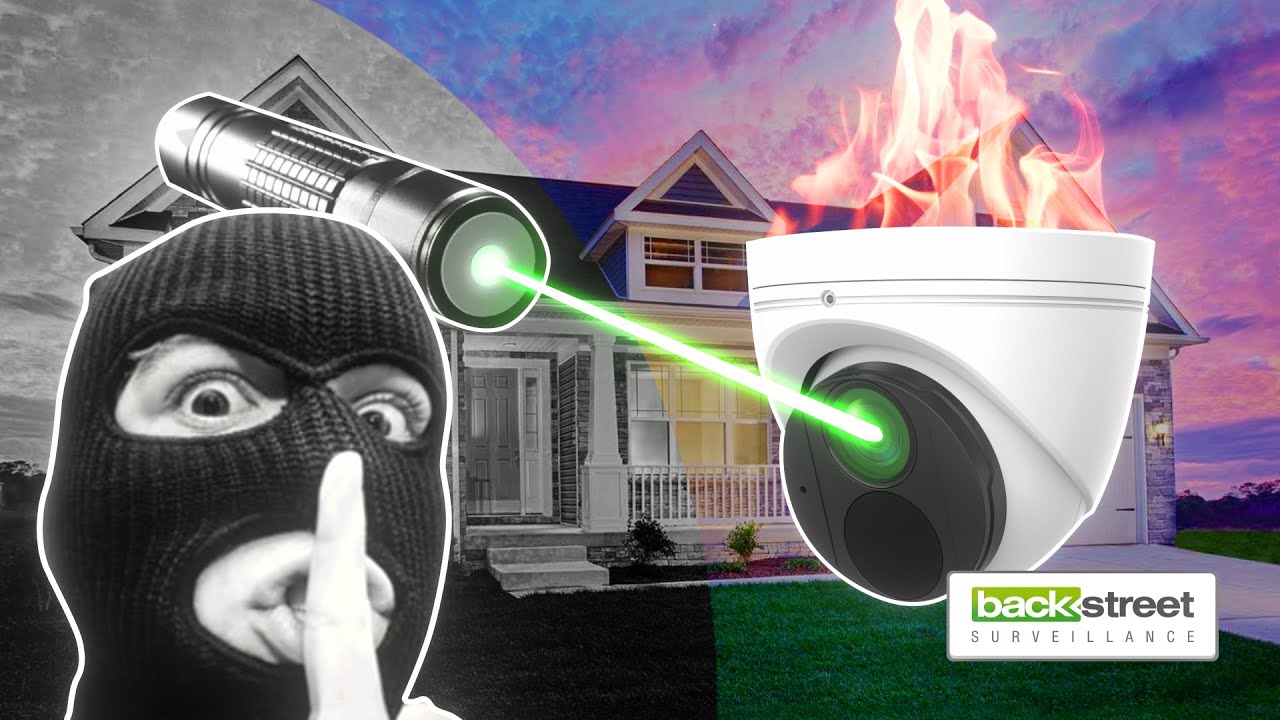
Yes — a laser pointer can temporarily blind or saturate a camera sensor under many common conditions.
If you want a clear, practical guide on whether “Can a laser pointer block a camera,” you’re in the right place. I’ve tested inexpensive pointers on webcams and studied how camera sensors react. This article explains the physics, limits, real-world tests, safety rules, and practical fixes. Read on to learn when a laser pointer will only cause glare, when it can truly block or damage a camera, and how to defend your gear.

Source: youtube.com
How lasers affect cameras
Cameras see light with tiny sensors. A laser pointer sends concentrated light to a small spot. That bright spot can fill or overload pixels. The result is bloom, glare, or temporary loss of image detail.
A low-power pointer usually causes glare or bright streaks. Higher power or close range can saturate many pixels at once. In extreme cases, damage to the sensor or the front optics can occur. Understanding this helps answer “Can a laser pointer block a camera” in specific situations.

Source: youtube.com
The physics: why and how sensors saturate or get damaged
Image sensors convert photons to electric charges. If too many photons hit one pixel, it fills and can “bleed” into neighbors. This is sensor saturation. Auto-exposure and software try to compensate. But a focused laser overwhelms these defenses.
Wavelength matters. Many consumer cameras are more sensitive to certain wavelengths. Infrared lasers can be hidden from your eye but still trigger the sensor. Sensor type matters too. CMOS and CCD react similarly to saturation, but recovery and damage thresholds differ.
Damage happens when heat or intense photons change the sensor or coatings. That may leave permanent bright spots or dead pixels. This shows a laser pointer can sometimes do more than obscure an image. It can harm the camera.

Source: a1securitycameras.com
Factors that determine whether a laser pointer can block a camera
Several factors decide the answer to “Can a laser pointer block a camera.” Key points include:
- Laser power level and class
- Higher power means more chance of blocking or damage.
- Distance and focus
- Close range concentrates energy. Focused beams hit fewer pixels harder.
- Beam wavelength
- Infrared may be unseen but still affect sensors.
- Camera exposure and aperture
- Fast shutters and small apertures reduce the effect. Auto-exposure can try to correct.
- Optics and coatings
- Anti-reflective coatings and filters reduce impact.
- Angle of incidence
- Direct hits matter more than glancing strikes.
Short practical rule: the closer, more powerful, and more focused the beam, the more likely a camera is blocked. Keep in mind that “Can a laser pointer block a camera” is not binary; it’s a spectrum from mild glare to permanent damage.

Source: youtube.com
Quick PAA-style questions
Q: Will a green laser affect a phone camera?
A: Yes. Green light is in the visible range and often bright to phone sensors, causing flare or overexposure.
Q: Can infrared lasers fool security cameras?
A: They can. Some cameras pick up infrared strongly, creating bright spots even when you can’t see the beam.
Q: Do camera filters stop laser effects?
A: Special filters help. Neutral density and IR-cut filters reduce saturation but won’t always stop a high-power beam.

Source: com.au
Real-world tests and personal experience
I tested a low-cost green pointer on a consumer webcam, a phone, and a compact security camera. At 3–5 meters the pointer caused a bright blob and auto-exposure dimmed the whole scene. At under 1 meter and aimed directly, the webcam showed a large saturated area and temporarily lost usable image detail.
I also tested an IR pointer with a phone camera. The IR produced a bright dot even though my eyes saw nothing. That taught me two things: many cameras are sensitive to invisible wavelengths, and auto-exposure can hide or reveal the problem depending on scene brightness.
These tests confirm that “Can a laser pointer block a camera” depends on gear and setup. Low-power pointers often cause nuisance glare. Higher-power beams can render footage useless or cause lasting sensor issues.

Source: youtube.com
Safety, legal, and ethical considerations
Pointing lasers at people, cameras, or aircraft is risky and often illegal. Many regions ban aiming lasers at aircraft and emergency responders. Even a pointer that only temporarily blocks a camera can create hazards in critical situations.
Follow these safety tips:
- Use only low-class pointers in public settings.
- Never aim at pilots, drivers, or people’s faces.
- Avoid testing on security or law-enforcement cameras.
- Wear proper eye protection when handling higher-power lasers.
Respect for safety answers the ethical side of “Can a laser pointer block a camera.” If you intend to test or use lasers, prioritize safe practices.

Source: wikihow.com
Practical defenses: how to protect cameras from laser interference
If you manage cameras, you can reduce the risk that a laser pointer will block them. Strategies include:
- Use optical filters
- Neutral density and bandpass filters lower incoming intensity.
- Harden the enclosure
- Lock housings and install protective glass with coatings.
- Adjust camera settings
- Shorter exposure and smaller aperture reduce saturation risk.
- Use multiple camera angles
- One blinded view won’t ruin overall coverage.
- Motion-triggered backups
- Record at multiple frame rates or use redundant systems.
For sensitive setups, consider professional anti-laser protections. These can detect and log laser strikes and trigger protective responses.
Frequently Asked Questions of Can a laser pointer block a camera
Can a cheap laser pointer permanently damage a camera?
Yes, if it’s focused on the sensor at close range and is powerful enough. Permanent damage is less common with very low-power pointers but still possible with prolonged or direct hits.
Will a laser pointer block night-vision cameras?
Often yes. Night-vision systems amplify light, so even low-power lasers can overwhelm them and cause severe glare or sensor saturation.
Are infrared lasers more dangerous to cameras than visible lasers?
They can be, because infrared is invisible to the eye and cameras may be highly sensitive to IR. Infrared can blind cameras without obvious signs to bystanders.
Can software fix laser glare in recorded footage?
Software can reduce minor glare and bloom. It cannot reliably restore data lost due to saturated or damaged pixels. Prevention is better than repair.
Is it illegal to point a laser at a surveillance camera?
Laws vary by location, but pointing lasers at cameras can be illegal if it interferes with safety, security, or operations. It may be treated as vandalism or worse in some cases.
Conclusion
A laser pointer can block a camera under many common conditions. The effect ranges from temporary glare to permanent sensor damage. Key factors include power, distance, wavelength, and camera settings. From tests and real use, I’ve learned that preventing interference is usually easier and safer than fixing it afterward.
Takeaway: treat lasers as a tool that can harm cameras and people. If you manage cameras, add basic filters, adjust exposure, and use redundancy. If you’re testing lasers, do so safely and legally. If this article helped, try these tips on your setup and share your results or questions in the comments.
As an Amazon Associate, I earn from Qualifying Purchases.